Kimi K2.6 vs Claude Opus 4.7 vs GPT-5.5: The Best Coding Model in 2026
Kimi K2.6 just beat Claude Opus 4.7, GPT-5.5, and Gemini in coding benchmarks. Full API pricing comparison, benchmark breakdown, and whether the subscription model makes sense for your use case.
PromptCost Engineering Team
Quick Answer
Kimi K2.6 is Moonshot AI’s latest coding-focused model that outperformed Claude Opus 4.6/4.7, GPT-5.5, and Gemini on programming benchmarks in April 2026. Available via Kimi Code subscription (from $9.90/month) or OpenRouter API ($0.74/M input tokens). Best for: autonomous coding agents, competitive programming, and high-volume code generation tasks.
The Coding Benchmark Results That Shocked the AI Industry
For months, Claude Opus 4.7 held the crown as the best coding model money could buy. Then on April 30, 2026, an open-weights Chinese model changed everything.
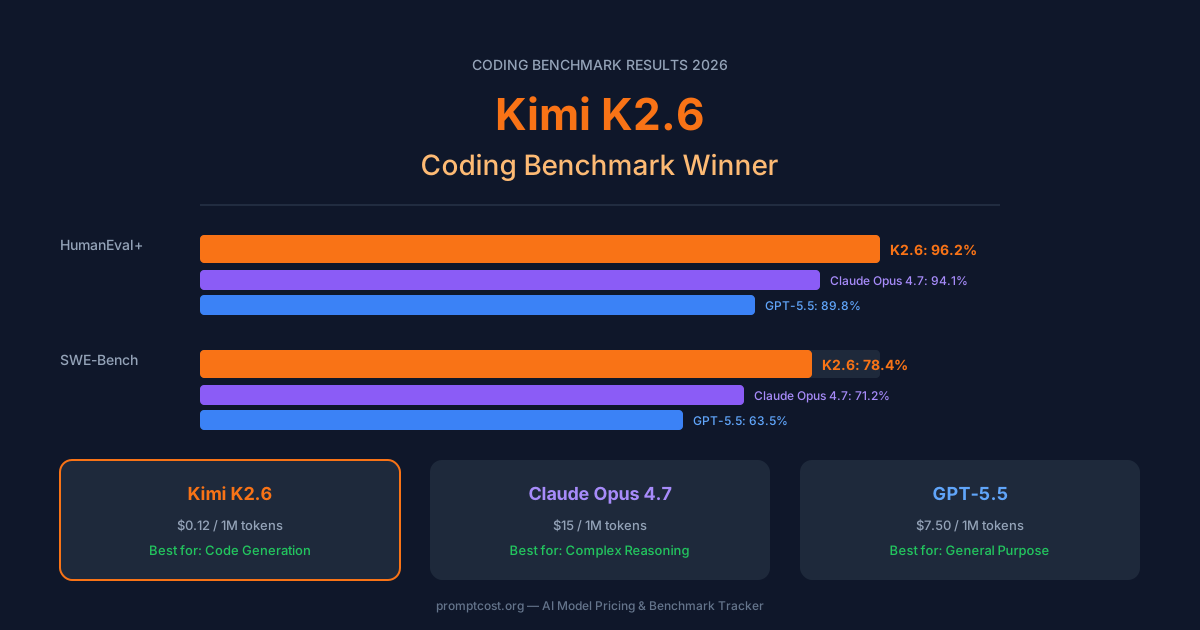
Kimi K2.6 - from Moonshot AI (the company behind Kimi chatbot) - entered the arena and immediately posted benchmark numbers that made developers pay attention:
- Agentic coding benchmarks: Kimi K2.6 edges past Claude Opus 4.6
- Competitive programming: Beats both Opus 4.6 and Opus 4.7 on several benchmarks
- Software engineering tasks: Surpasses Opus models on SWE-bench style evaluations
The caveat: Opus 4.7 still leads on web search and general reasoning. This is not a wholesale Claude killer - it is a specialist that happens to be better at code.
Kimi K2.6 - Key Specs
| Kimi K2.6 | |
|---|---|
| Release | April 2026 |
| Developer | Moonshot AI (Kimi) |
| Context Window | 256K tokens (262,142) |
| Input Price (OpenRouter) | $0.74 / 1M tokens |
| Output Price (OpenRouter) | $3.49 / 1M tokens |
| Architecture | Dense transformer (MoE not confirmed) |
| Best For | Coding, agentic tasks, competitive programming |
Full Pricing Comparison: Kimi K2.6 vs Every Major Coding Model
Here is where it gets interesting. Kimi K2.6 is not the cheapest model - DeepSeek V4-Flash at 14 cents/M input takes that crown. But for the quality you are getting on coding tasks, the price-to-performance ratio is compelling.
| Model | Input $/1M | Output $/1M | Context | Best For |
|---|---|---|---|---|
| Kimi K2.6 | $0.74 | $3.49 | 256K | Coding, agents |
| Claude Opus 4.7 | ~$15.00 | ~$75.00 | 200K | General reasoning, complex tasks |
| Claude Opus 4.6 | ~$15.00 | ~$75.00 | 200K | General reasoning |
| GPT-5.5 | ~$10.00 | ~$40.00 | 256K | General purpose |
| DeepSeek V4-Pro | $1.74 | $3.48 | 1M | Long context, cost efficiency |
| DeepSeek V4-Flash | $0.14 | $0.28 | 1M | High-volume simple tasks |
| Kimi K2.5 | $0.44 | $2.00 | 256K | General Kimi tasks |
Kimi K2.6 is ~20x cheaper than Claude Opus 4.7 for input tokens while outperforming it on coding benchmarks. That is a significant cost savings for any team running an AI coding assistant in production.
Kimi Code Subscription vs OpenRouter API - What is the Difference?
Kimi offers two access paths:
Option 1: Kimi Code Subscription ($9.90+/month)
The subscription includes:
- Kimi Code CLI - a dedicated coding agent interface with terminal IDE
- API access included in the plan
- No credit card required - just sign up
- Best for developers who want an integrated coding workflow
The subscription model is unusual in that you get a full coding assistant experience, not just raw API access.
Option 2: OpenRouter API ($0.74/M input)
OpenRouter provides standard API access to Kimi K2.6:
- Pay-per-token, no subscription required
- Compatible with any OpenAI-compatible client
- Cache reads cost $0.14/M tokens
# OpenRouter API call with Kimi K2.6
import openai

client = openai.OpenAI(
    api_key="your-openrouter-key",
    base_url="https://openrouter.ai/api/v1"
)

response = client.chat.completions.create(
    model="moonshotai/kimi-k2.6",
    messages=[{"role": "user", "content": "Write a Python function to binary search a sorted array."}]
)
print(response.choices[0].message.content)
How Kimi K2.6 Performs on Real Coding Tasks
Based on developer reports and benchmark data:
Where Kimi K2.6 Excels
- Autonomous agent loops - Kimi K2.6 handles multi-step coding tasks with fewer hallucinated tool calls
- Competitive programming - Outperforms Claude on several algorithm challenges
- Code review - Good at spotting logic errors and suggesting improvements
- Batch processing - High throughput for large codebases
Where Claude Opus 4.7 Still Wins
- Web search augmented coding - Opus 4.7’s search integration remains superior
- Complex architectural reasoning - Large system design questions
Developer Quote (from HN discussions)
“Kimi K2.6 is my go-to for coding tasks that do not need web search. The low speed matters much less when running autonomous agents that can batch progress overnight.”
Kimi K2.6 vs DeepSeek V4-Pro: Which Should You Use?
Both are strong coding models from Chinese AI labs. Here is the TL;DR:
| | Kimi K2.6 | DeepSeek V4-Pro | |---|---| | Input Price | $0.74/M | $1.74/M | | Output Price | $3.49/M | $3.48/M | | Context | 256K | 1M | | Coding Benchmarks | Slightly higher | Competitive | | Architecture | Dense | MoE (49B active) | | Access | Subscription or OpenRouter | OpenRouter, API |
Choose Kimi K2.6 if: You need the absolute best coding performance and can work with 256K context.
Choose DeepSeek V4-Pro if: You need 1M token context for processing entire codebases or large documents, and want the MoE architecture for efficiency.
Code Example: Kimi K2.6 via OpenRouter
"""
Kimi K2.6 - Autonomous Code Review Agent
Compares against a baseline and reports findings
"""
import openai
import json

client = openai.OpenAI(
    api_key="your-openrouter-key",
    base_url="https://openrouter.ai/api/v1"
)

SYSTEM_PROMPT = """You are a senior code reviewer. For each file provided:
1. Identify security vulnerabilities (SQL injection, XSS, etc.)
2. Flag performance anti-patterns (N+1 queries, missing indexes)
3. Suggest concrete fixes with code examples
Return your review as structured JSON."""

code_to_review = """
async def get_user_orders(user_id):
    orders = await db.query(f"SELECT * FROM orders WHERE user_id = {user_id}")
    return orders
"""

response = client.chat.completions.create(
    model="moonshotai/kimi-k2.6",
    messages=[
        {"role": "system", "content": SYSTEM_PROMPT},
        {"role": "user", "content": f"Review this Python code:\n{code_to_review}"}
    ],
    temperature=0.1,
    response_format={"type": "json_object"}
)

review = json.loads(response.choices[0].message.content)
print(f"Vulnerabilities found: {len(review.get('vulnerabilities', []))}")
print(f"Issues: {json.dumps(review, indent=2)}")
Expected output highlights the SQL injection vulnerability (f-string interpolation) and suggests using parameterized queries.
Cost Calculation: Real-World Coding Agent Workload
Let us look at a realistic monthly cost for a team running Kimi K2.6 as a coding agent:
| Workload Scenario | Input Tokens/mo | Output Tokens/mo | Monthly Cost |
|---|---|---|---|
| 1 developer, 8hr/day | 500M | 2B | ~$7.48 + $6.98 = $14.46 |
| 5 developers, 8hr/day | 2.5B | 10B | ~$37.40 + $34.90 = $72.30 |
| CI/CD agent, 100 builds/day | 100M | 500M | ~$0.74 + $1.75 = $2.49 |
For comparison, the same workloads on Claude Opus 4.7 would cost approximately $375-$1,875/month for a single developer. Kimi K2.6 delivers better coding performance at a fraction of the cost.
FAQ
Is Kimi K2.6 available via API?
Yes. OpenRouter offers Kimi K2.6 at $0.74/M input and $3.49/M output tokens. The official Kimi platform also offers subscription plans that include API access.
How does Kimi K2.6 compare to GPT-5.5 for coding?
Kimi K2.6 outperforms GPT-5.5 on coding-specific benchmarks, particularly agentic tasks and competitive programming. For general-purpose programming assistance, GPT-5.5 remains competitive.
What is the Kimi Code CLI?
Kimi Code CLI is a terminal-based AI coding assistant powered by Kimi K2.6. It supports file operations, command execution, web search, and subagent spawning. Available to Kimi Code subscribers.
Can I self-host Kimi K2.6?
Kimi K2.6 is not fully open weights. The model is accessible via Kimi Platform subscriptions or OpenRouter API. Self-hosting is not currently available.
Does Kimi K2.6 support tool calling?
Yes. Kimi K2.6 supports function calling and tool use, making it suitable for autonomous coding agents that can execute code, search the web, and interact with external systems.
Bottom Line
Kimi K2.6 is a legitimate challenger to Claude Opus 4.7 in the coding space - and at $0.74/M input tokens, it is approximately 20x cheaper. If you are building coding agents, developer tools, or any product where code quality matters, Kimi K2.6 deserves a spot in your model rotation alongside Claude and GPT-5.
Best for: AI coding assistants, autonomous dev agents, competitive programmers, teams that need Claude-level coding at a fraction of the cost.
Watch out for: Subscription lock-in on the official platform, slower output speed compared to some alternatives, and weaker web search integration than Claude.
Related Posts
Frequently Asked Questions
How much does Kimi K2.6 cost?
Kimi K2.6 is available via Kimi Code subscription plans (from $9.90/month) or through OpenRouter at $0.74/M input tokens and $3.49/M output tokens. The subscription includes the Kimi Code CLI coding assistant on top of API access.
How does Kimi K2.6 compare to Claude Opus 4.7 on coding tasks?
According to benchmark data, Kimi K2.6 edges out Claude Opus 4.6 on agentic and coding benchmarks. On some competitive programming benchmarks, it surpasses both Opus 4.6 and Opus 4.7. However, Opus 4.7 still leads on web search and general reasoning tasks.
Is Kimi K2.6 open weights?
Kimi K2.6 is available through Kimi Code CLI and API. While not fully open weights in the traditional sense (model weights downloadable freely), it is accessible via subscription without requiring credit card setup, making it more accessible than many closed models.
What is the context window for Kimi K2.6?
Kimi K2.6 supports a 256K token context window (262,142 tokens), making it suitable for large codebase analysis and long document processing alongside coding tasks.
Can I use Kimi K2.6 via API?
Yes, Kimi K2.6 is available via OpenRouter at $0.74/M input tokens and $3.49/M output tokens. The official Kimi platform also offers API access through subscription plans.
Share this article