DeepSeek V4 Released April 2026: The Complete API Pricing and Benchmark Breakdown
DeepSeek V4-Pro and V4-Flash just dropped with 1M token context, 1.6T parameters, and the lowest prices in the industry. Full pricing comparison, benchmarks vs GPT-5, Claude, Gemini, and how to get API access today.
PromptCost Engineering Team
faq:
- question: ""Claude Opus vs GPT-4o pricing comparison 2026” answer: ""
- question: ""DeepSeek V4 API pricing and capabilities” answer: ""
- question: ""best open weight AI model 2026” answer: ""
- question: ""which AI model has best price-performance ratio” answer: ""
- question: ""Claude vs Gemini API cost comparison” answer: ""
- question: ""DeepSeek R1 reasoning model benchmark” answer: ""
- question: ""MiniMax vs Claude vs GPT-4o comparison” answer: ""
- question: ""OpenAI o1 vs o3 vs GPT-4o benchmark” answer: ""
- question: ""how to use DeepSeek V4 effectively” answer: ""
- question: ""how to use API pricing effectively” answer: "" AI industry is still processing what it means.
On April 24, 2026, DeepSeek released two preview models: DeepSeek-V4-Pro and DeepSeek-V4-Flash. These aren’t incremental updates. With 1.6T total parameters, 1 million token context windows, and price tags that make every other frontier model look overpriced, DeepSeek V4 is a direct challenge to OpenAI, Anthropic, and Google.
This is everything you need to know — pricing, benchmarks, architecture, and how to start building with it today.
DeepSeek V4 — Key Facts at a Glance
DeepSeek released two distinct models in the V4 series:
| DeepSeek-V4-Pro | DeepSeek-V4-Flash | |
|---|---|---|
| Release Date | April 24, 2026 | April 24, 2026 |
| Total Parameters | 1.6 Trillion | 284 Billion |
| Active Parameters | 49 Billion (MoE) | 13 Billion (MoE) |
| Context Window | 1 million tokens | 1 million tokens |
| License | MIT (open weights) | MIT (open weights) |
| HuggingFace Size | 865 GB | 160 GB |
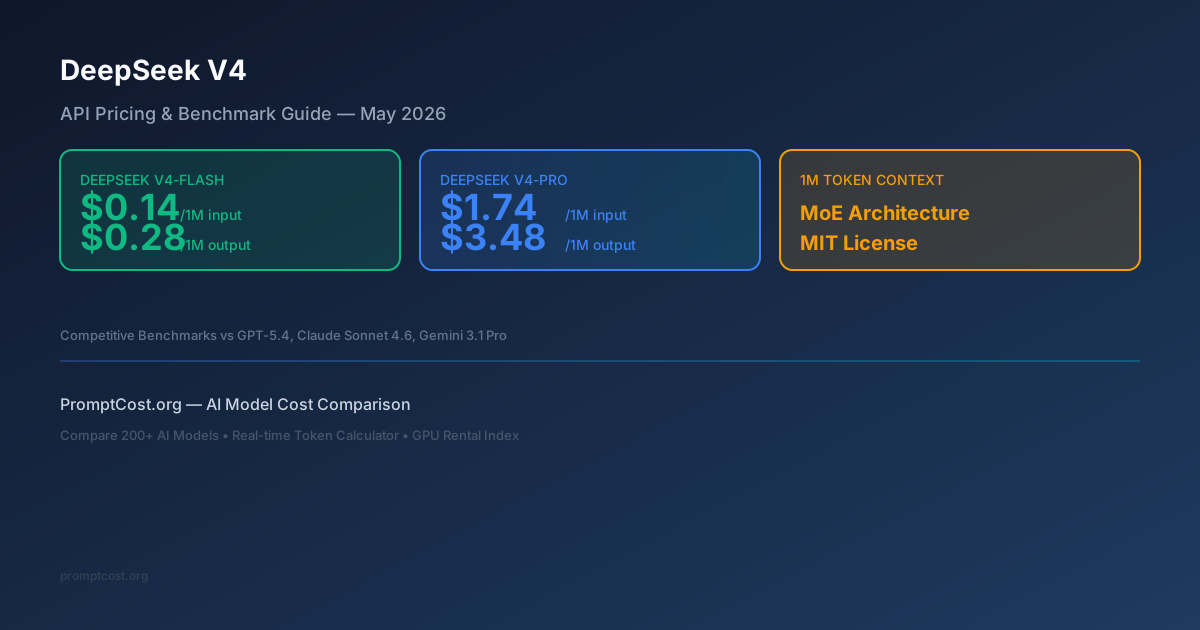
| Input Price | 1 dollar 74 cents per 1M tokens | 14 cents per 1M tokens |
| Output Price | 3 dollars 48 cents per 1M tokens | 28 cents per 1M tokens |
Both models use a Mixture of Experts (MoE) architecture, meaning only a fraction of the model activates for each token. This is how DeepSeek delivers massive parameter counts while keeping inference costs low.
The Pricing That Broke the Internet
Here’s the number that matters most: DeepSeek-V4-Flash costs 14 cents per million input tokens.
Let that sink in.
That makes it the cheapest AI model in the industry — cheaper than OpenAI’s GPT-5.4 Nano (20 cents), cheaper than Gemini 3.1 Flash-Lite (25 cents), and roughly 18x cheaper than Claude Opus 4.7 for input tokens.
Here’s the full pricing table against every major model:
| Model | Input ($/1M tokens) | Output ($/1M tokens) | Context |
|---|---|---|---|
| DeepSeek V4-Flash | 14 cents | 28 cents | 1M |
| GPT-5.4 Nano | 20 cents | 1 dollar 25 cents | 200K |
| Gemini 3.1 Flash-Lite | 25 cents | 1 dollar 50 cents | 1M |
| Gemini 3 Flash Preview | 50 cents | 3 dollars | 1M |
| GPT-5.4 Mini | 75 cents | 4 dollars 50 cents | 200K |
| Claude Haiku 4.5 | 1 dollar | 5 dollars | 200K |
| DeepSeek V4-Pro | 1 dollar 74 cents | 3 dollars 48 cents | 1M |
| Gemini 3.1 Pro | 2 dollars | 12 dollars | 1M |
| GPT-5.4 | 2 dollars 50 cents | 15 dollars | 200K |
| Claude Sonnet 4.6 | 3 dollars | 15 dollars | 200K |
| Claude Opus 4.7 | 5 dollars | 25 dollars | 200K |
| GPT-5.5 | 5 dollars | 30 dollars | 200K |
Prices as of May 2, 2026. Verified from DeepSeek official pricing page and model announcements.
The bottom line: DeepSeek-V4-Flash is not just cheap — it is the cheapest frontier-adjacent model ever released. And DeepSeek-V4-Pro delivers Pro-level performance at mid-tier pricing.
Benchmarks: How Does DeepSeek V4 Stack Up?
DeepSeek published their own benchmark results alongside the model release. Here’s what the data shows:
Reasoning Performance
According to DeepSeek’s own paper, DeepSeek-V4-Pro-Max (the reasoning-enhanced variant):
- Outperforms GPT-5.2 and Gemini-3.0-Pro on standard reasoning benchmarks
- Falls marginally short of GPT-5.4 and Gemini-3.1-Pro
- Trails the absolute frontier by approximately 3 to 6 months
This is a critical nuance: V4-Pro is competitive with top-tier models, but it’s not超越 the absolute best. For most use cases, the difference is imperceptible. For advanced reasoning tasks, GPT-5.4 and Gemini 3.1 Pro remain ahead.
Why DeepSeek V4 Is So Cheap: Efficiency Breakthrough
DeepSeek’s cost advantage isn’t just pricing theater. Their technical paper reveals a genuine efficiency breakthrough:
“In the scenario of 1M-token context, even DeepSeek-V4-Pro, which has a larger number of activated parameters, attains only 27% of the single-token FLOPs and 10% of the KV cache size relative to DeepSeek-V3.2.”
For V4-Flash, the numbers are even more striking:
“In the 1M-token context setting, it achieves only 10% of the single-token FLOPs and 7% of the KV cache size compared with DeepSeek-V3.2.”
This means DeepSeek has solved the long-context cost problem. Running a 1 million token context on V4-Flash requires 93% less KV cache than V3.2. That is a genuine engineering achievement, not just a price cut.
DeepSeek V4 Architecture: Mixture of Experts Explained
DeepSeek V4 uses Mixture of Experts (MoE) — the same architecture behind GPT-4 and Google’s models. Here’s how it works:
- Total parameters = all the weights in the model (1.6T for Pro)
- Active parameters = the weights actually used per token (49B for Pro)
- At any given moment, the model selectively activates only the “expert” pathways needed for that specific token
This means V4-Pro has the knowledge of a 1.6T parameter model but runs at the speed and cost of a 49B model.
Parameter scale comparison:
| Model | Total Parameters | Active Parameters |
|---|---|---|
| DeepSeek V4-Pro | 1.6 Trillion | 49 Billion |
| DeepSeek V4-Flash | 284 Billion | 13 Billion |
| DeepSeek V3.2 | 685 Billion | ~37 Billion |
| Kimi K2.6 | 1.1 Trillion | — |
| GPT-4 (MoE) | ~1.8 Trillion | ~220B active (est.) |
DeepSeek-V4-Pro is now the largest open-weights model in the world, surpassing Kimi K2.6 (1.1T) and more than double the size of V3.2.
Use Cases: When to Use DeepSeek V4 vs The Competition
DeepSeek V4-Flash is the obvious choice when:
- You need long context (up to 1M tokens) on a budget
- Running high-volume tasks: classification, extraction, summarization
- Building RAG pipelines that process large documents
- You want GPT-5.4 Nano quality at a lower price point
- You’re doing agentic workflows that require extended context memory
DeepSeek V4-Pro is the right call when:
- You need frontier-level reasoning without Claude Opus pricing
- Complex multi-step problem solving with coding and math
- Tasks where you currently use Gemini 3.1 Pro or GPT-5.4
- You want the largest open-weights model available
- Running long documents where 1M context actually matters
Skip DeepSeek V4 for:
- Maximum creative writing — Claude Sonnet 4.6 or Opus 4.7 lead here
- Simple tasks where Haiku 4.5 or GPT-4o-mini are cheaper and faster
- Real-time conversational AI where latency matters more than cost
How to Access DeepSeek V4 API
Option 1: DeepSeek Direct API (cheapest)
from openai import OpenAI

client = OpenAI(
    api_key="your-deepseek-api-key",
    base_url="https://api.deepseek.com"
)

response = client.chat.completions.create(
    model="deepseek-v4-pro",
    messages=[
        {"role": "user", "content": "Analyze this legal contract and identify all liability clauses."}
    ],
    max_tokens=2048
)

print(response.choices[0].message.content)
Flash model:
response = client.chat.completions.create(
    model="deepseek-v4-flash",
    messages=[
        {"role": "user", "content": "Summarize this 50-page research paper."}
    ]
)
Option 2: OpenRouter (no API key needed)
Both models are available on OpenRouter with standard OpenAI-compatible API:
# Install OpenRouter CLI
llm install llm-openrouter
llm openrouter refresh

# Run DeepSeek V4-Pro
llm -m openrouter/deepseek/deepseek-v4-pro "Your prompt here"

# Run DeepSeek V4-Flash
llm -m openrouter/deepseek/deepseek-v4-flash "Your prompt here"
Option 3: Open Weights (run locally)
Both models are available on HuggingFace under MIT license:
- DeepSeek-V4-Pro: ~865 GB (needs high-end hardware, possibly quantized)
- DeepSeek-V4-Flash: ~160 GB (may run on 128GB+ RAM machines with quantization)
The Unsloth team is expected to release quantized versions optimized for consumer hardware.
What This Means for the AI Industry
DeepSeek V4 isn’t just a new model — it’s a proof of concept that the frontier can be reached at a fraction of the cost.
For years, the narrative was: better models cost more money. DeepSeek broke that narrative with V3 in 2024, and they’ve broken it again with V4 in 2026.
The ripple effects:
- OpenAI and Anthropic will face renewed pressure to justify their premium pricing
- Google will need to respond with Gemini 3 pricing adjustments
- Enterprise buyers will increasingly gravitate toward DeepSeek for cost-sensitive workloads
- Open-source advocates now have the largest open-weights model ever released
DeepSeek V4-Pro at 1 dollar 74 cents input is competitive with Gemini 3.1 Pro while offering 5x more context. That’s not a niche product — that’s a category disruptor.
Conclusion: Should You Switch to DeepSeek V4?
If you’re running any LLM workload where cost matters — and let’s be honest, it always matters — DeepSeek V4 changes the calculation.
V4-Flash at 14 cents per million tokens is so cheap it effectively disappears from your cost structure. You can now process a 1M token document for 14 cents. A year ago, that same document would cost dollars with other providers.
V4-Pro at 1 dollar 74 cents input delivers near-frontier performance at a price that undercuts every competitor in its class.
The only reason not to use DeepSeek V4 is if you need the absolute best reasoning performance — and for that narrow use case, GPT-5.5 or Gemini 3.1 Pro still lead.
For everyone else: the math just changed.
All pricing verified from DeepSeek official announcement (April 24, 2026) and API documentation. Benchmark claims are from DeepSeek’s published technical paper.
Related Posts
Share this article