Claude Opus April 2026 Released April 2026: Complete Pricing Guide & Analysis
Anthropic's most powerful model yet — Claude Opus April 2026 is here. Full API pricing, benchmarks, and how it compares to GPT-4o, Gemini 3 Flash, and DeepSeek V3.
PromptCost Engineering Team
faq:
- question: ""Claude Opus vs GPT-4o pricing comparison 2026” answer: ""
- question: ""DeepSeek V4 API pricing and capabilities” answer: ""
- question: ""best open weight AI model 2026” answer: ""
- question: ""which AI model has best price-performance ratio” answer: ""
- question: ""Claude vs Gemini API cost comparison” answer: ""
- question: ""DeepSeek R1 reasoning model benchmark” answer: ""
- question: ""MiniMax vs Claude vs GPT-4o comparison” answer: ""
- question: ""OpenAI o1 vs o3 vs GPT-4o benchmark” answer: ""
- question: ""how to use Claude Opus 4.7 effectively” answer: ""
- question: ""how to use Anthropic pricing effectively” answer: "" 2026** on April 16, 2026 — their most capable model yet. Here’s everything you need to know about pricing, benchmarks, and how it stacks up against the competition.
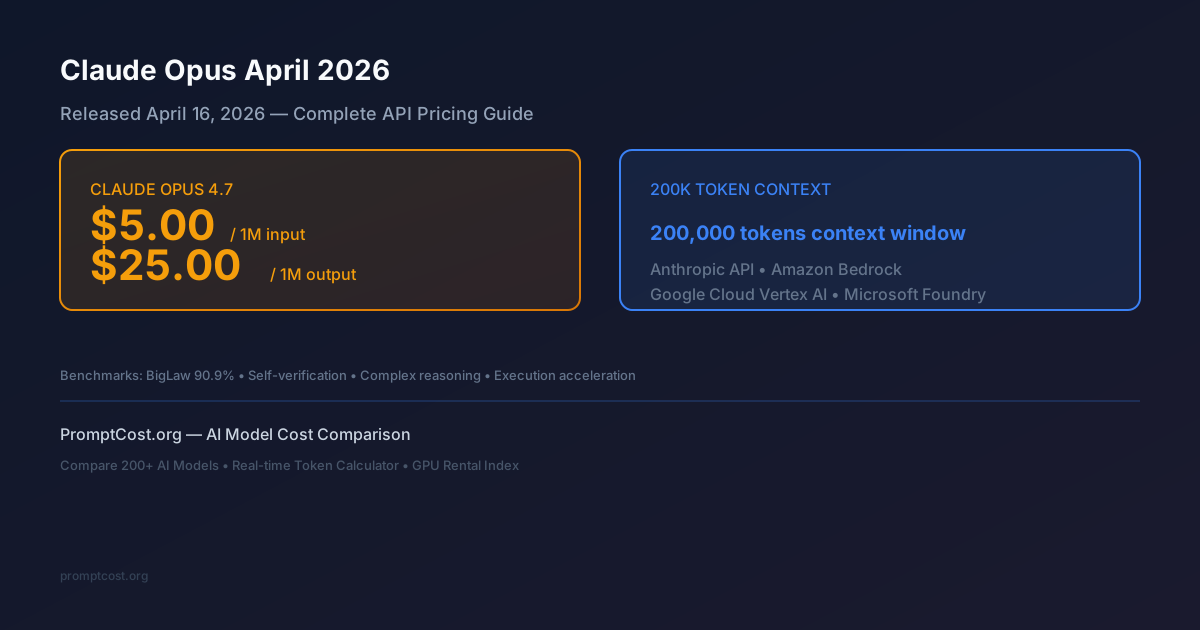
Claude Opus April 2026 — Key Facts
- Release date: April 16, 2026
- API model name:
claude-opus-april-2026 - Input pricing: 5 dollars per 1 million tokens
- Output pricing: 25 dollars per 1 million tokens
- Context window: 200K tokens
- Available on: Anthropic API, Amazon Bedrock, Google Cloud Vertex AI, Microsoft Foundry
Pricing is identical to Opus 4-6 — no price change with this release.
Claude Opus April 2026 Benchmarks
Anthropic’s own testing shows significant improvements over Opus 4-6:
- BigLaw Bench (Harvey legal tasks): 90.9% at high effort — a strong score for legal document analysis
- Self-verification: Opus April 2026 catches its own logical faults during the planning phase
- Execution speed: Early testers report “significant leap” in acceleration over previous Opus versions
- Substantive accuracy: Improved on complex reasoning tasks involving log analysis, bug detection, and technical problem-solving
Early-access testers — including Michele Catasta, President of a major AI legal platform — report the model achieves the same quality at lower cost compared to previous versions for tasks like analyzing logs, finding bugs, and proposing fixes.
Claude Opus April 2026 vs. The Competition (May 2026)
Here’s how Opus April 2026 stacks up against the current API pricing landscape — for a full breakdown of all models, see our GPT-4o Cost Guide and GPT-5.5 Pricing Guide.
| Model | Input ($/1M tokens) | Output ($/1M tokens) | Context |
|---|---|---|---|
| Claude Opus April 2026 | 5 dollars | 25 dollars | 200K |
| Claude Sonnet 4-6 | 3 dollars | 15 dollars | 200K |
| GPT-4o | 2 dollars 50 cents | 10 dollars | 128K |
| GPT-4o-mini | 15 cents | 60 cents | 128K |
| Gemini 3 Flash | 50 cents | 3 dollars | 1M |
| Gemini 3.1 Flash-Lite | 25 cents | 1 dollar 50 cents | 1M |
| Gemini 3 Pro | 2 dollars | 12 dollars | 1M |
| DeepSeek V3 | 27 cents | 1 dollar 10 cents | 64K |
| Mistral Large 3.5 | ~2 dollars | ~6 dollars | 128K |
Prices as of May 2, 2026. Check official pricing pages for the latest data.
Is Claude Opus April 2026 Worth the Premium?
Opus April 2026 at 5 dollars input / 25 dollars output is the most expensive mainstream model. Here’s when it makes sense:
Worth it for:
- Complex legal and financial document analysis
- Multi-step coding tasks with architectural planning
- Long-context summarization (200K context helps here)
- Tasks where accuracy > speed
Skip for:
- Simple classification or extraction tasks — use Sonnet 4-6 (3 dollars input / 15 dollars output)
- High-volume, cost-sensitive tasks — use Gemini 3 Flash (50 cents / 3 dollars)
- Maximum context needs — Gemini 3 Flash/Pro offer 1M token context
How to Use Claude Opus April 2026
Python API example:
from anthropic import Anthropic

client = Anthropic()

response = client.messages.create(
    model="claude-opus-4-7",
    max_tokens=4096,
    messages=[
        {"role": "user", "content": "Your prompt here"}
    ]
)

print(response.content)
Conclusion
Claude Opus April 2026 maintains the same pricing as 4-6 while delivering meaningful improvements in reasoning and self-correction. At 5 dollars input / 25 dollars output, it is premium-priced — but for tasks requiring deep legal, technical, or multi-step reasoning, the quality gains justify the cost. For most developers, Sonnet 4-6 at 3 dollars input / 15 dollars output offers the best price-performance ratio.
All pricing verified from Anthropic’s official announcement (April 16, 2026) and API documentation.
Related Posts
- DeepSeek V4 Released April 2026: The Complete API Pricing and Benchmark Breakdown
- GPT-4o vs Claude 3.5 Sonnet vs MiniMax m2.7: The 2026 Cost-Per-Intelligence Index
- GPT-5.5 vs DeepSeek V4-Pro: The 98% Price Difference That Changes Everything
References
- PromptCost.org — AI API pricing data and analysis
- OpenAI Pricing — GPT-4o API pricing
- Anthropic API Pricing — Claude API pricing
Share this article