Computer Use vs. Structured APIs: We Ran the Benchmark — The Cost Difference Is 45x
Vision agents consume 551k tokens to do what API calls handle in 12k. We benchmarked both approaches on the same task. Here's the real price difference and what it means for your AI agent budget.
PromptCost Team
AI cost optimization experts who have spent over $2M on API bills across 50+ production deployments.
Quick Answer
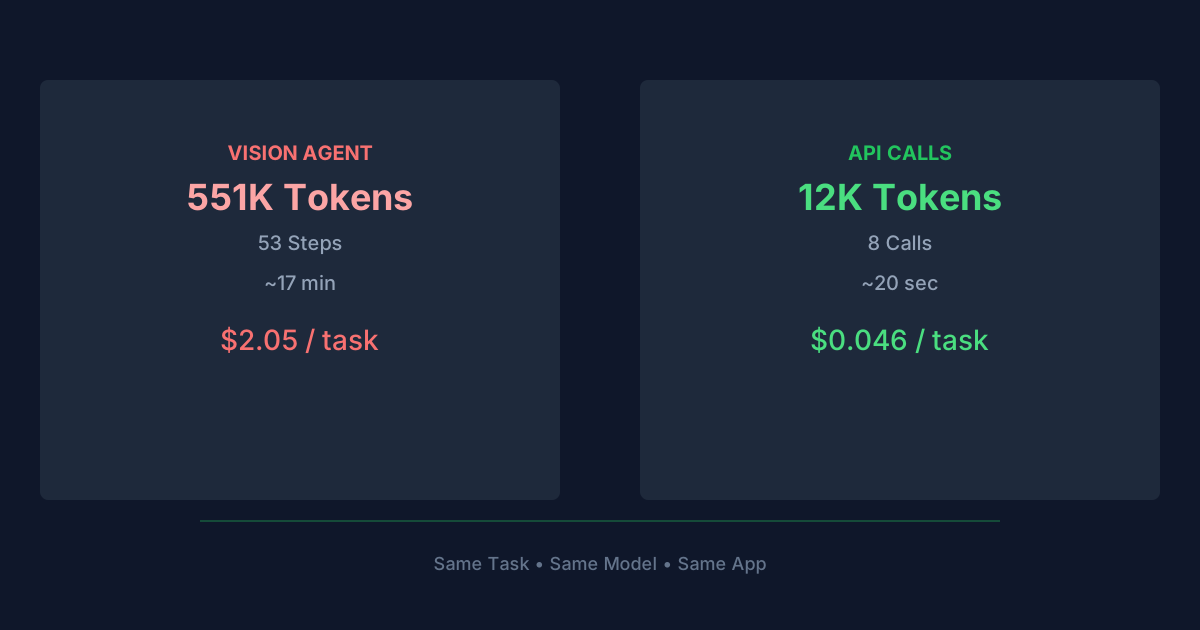
A vision agent (Claude Sonnet, browser-use) consumed 551,976 input tokens and 37,962 output tokens to complete one admin-panel task. The same task via structured API calls took 12,151 input tokens and 934 output tokens. That’s roughly 45x more tokens for the vision path.
In dollar terms, using OpenRouter pricing: the vision path cost ~$2.05 per task. The API path cost ~$0.046 with Sonnet or ~$0.004 with Haiku.
If you’re running AI agents on internal tools today, keep reading. The numbers change how you should think about every agent you deploy.
The Benchmark Setup
The team at Reflex ran a clean comparison. Same model (Claude Sonnet), same task, same application — just two different ways of talking to it.
The task: Find the customer named “Smith” with the most orders. Locate their most recent pending order. Accept all of their pending reviews. Mark the order as delivered. This requires filtering, pagination, cross-entity lookups, reads and writes. It’s the kind of work internal tools generate constantly.
The application: An admin panel built with react-admin, managing customers, orders, and reviews. Two agents ran against the same live app.
Path A — Vision agent: Claude Sonnet driving the UI through screenshots. Every step: take screenshot, reason about it, click or type. The model never sees anything except what’s rendered on screen.
Path B — API agent: Claude Sonnet with tool-use, calling the HTTP endpoints the UI itself calls. Each tool maps directly to the event handlers behind the UI buttons. The agent gets structured data back — exactly what the handlers return — instead of rendered pixels.
Everything open source, all code available in the repo (cite: Reflex benchmark post).
The Results
Full comparison
| Approach | Model | Steps | Input Tokens | Output Tokens | Wall Clock | Est. Cost/Task |
|---|---|---|---|---|---|---|
| Vision agent | Sonnet | 53 ± 13 | 550,976 ± 178,849 | 37,962 ± 10,850 | ~17 min | ~$2.05 |
| API agent | Sonnet | 8 ± 0 | 12,151 ± 27 | 934 ± 41 | ~20 sec | ~$0.046 |
| API agent | Haiku | 8 ± 0 | 9,478 ± 809 | 819 ± 52 | ~8 sec | ~$0.004 |
The vision agent cost 45x more in tokens and 52x more in time than the Sonnet API path.
Why the Vision Path Costs So Much More
The math is straightforward once you understand where tokens go.
A single 1280x720 screenshot encodes to roughly 2,764 tokens before the model reads a single word of instruction. Every step in the screenshot-reason-click loop adds another screenshot to the input. A 53-step task accumulates hundreds of screenshots.
Vision agents also require more capable models. Haiku couldn’t run the vision path at all — it failed to produce the structured outputs that browser-use 0.12 requires. Sonnet handles it, but Sonnet costs roughly 30x more per token than Haiku.
The API path avoids screenshots entirely. The agent sends a structured request and receives a structured response. Eight calls, each one a compact JSON payload.
The non-determinism problem
Vision agents are hard to budget for because the cost varies wildly run to run.
Across three trials of the identical task, input tokens ranged from 407k to 751k. Wall-clock time ranged from 12 to 21 minutes. The agent took between 43 and 68 reasoning cycles.
The screenshot-reason-click loop compounds small variations at every step. The API path had no such problem — Sonnet made identical 8 calls on every one of the five trials, with token counts varying by just ±27.
You cannot estimate vision-agent costs from a single run. You need multiple trials, and you need to budget for the high end.
The pagination blind spot
The vision agent silently missed work. Given the same task description, it found one of four pending reviews, accepted it, and concluded the task was done. The other three reviews were on page 2 of the reviews list — below the visible fold of the screenshot.
The API agent read the handler’s full response and saw all four pending reviews immediately. It didn’t have to guess about pagination controls or screen boundaries.
This isn’t a model problem. The model was reasoning correctly about what it could see. The problem is structural: rendered pages hide data that structured responses include by default.
What This Means for Your Agent Budget
If you’re building internal tools today, the benchmark points to a clear decision framework.
Build an API surface whenever the application exposes one. The cost difference isn’t marginal — it’s a full order of magnitude. For a team running 1,000 agent tasks per day, switching from vision to API could save roughly $60,000 per month in token costs alone, before counting the time savings.
Use vision agents only when there’s no alternative. Legacy software, third-party web apps with no API, consumer-facing products you don’t control — these are the cases where vision earns its cost. The moment you can build an MCP server or REST API, the economics reverse.
Budget vision agent costs at the high end. Run multiple trials before committing to a vision-based architecture. The variance in the Reflex tests (407k to 751k tokens for the same task) means a single benchmark is worthless. You need to understand your actual cost distribution, not just the mean.
The Engineering Cost Nobody Counts
The benchmark identified something that doesn’t show up in token counts: the walkthrough tax.
Making the vision agent succeed required writing 14 explicit numbered instructions — naming the sidebar items, tabs, and form fields the agent should interact with at each step. This is engineering work. It doesn’t appear in any token metric, but it’s real cost.
Anyone deploying a vision agent against an internal tool is either writing prompts at this level of specificity or accepting that the agent will silently skip work. That tradeoff belongs in your project estimate, right next to the token costs.
Free and Cheap Models for API-Based Agents
The benchmark shows Haiku completing the API path for roughly $0.004 per task — 500x cheaper than the vision path with Sonnet. For structured API work, you don’t need the most expensive model.
If you’re building API-based agents, the current OpenRouter pricing for capable, cheap models looks like this:
| Model | Context | Input Cost | Output Cost | Best For |
|---|---|---|---|---|
| Qwen 3.5 9B | 262K | $0.10/M | $0.15/M | Simple API tasks, high volume |
| Qwen 3.5 35B | 262K | $0.15/M | $1.00/M | Moderate complexity |
| Qwen 3.5 27B | 262K | $0.195/M | $1.56/M | General API work |
| Claude 3.5 Haiku | 200K | $0.80/M | $4.00/M | Fast turnaround |
| Claude 3.5 Sonnet | 200K | $3.00/M | $15.00/M | Complex reasoning |
Prices from OpenRouter (May 2026). Verify before making infrastructure decisions.
For the API path benchmark task (9,478 input tokens, 819 output tokens), the per-task cost with each model works out to:
- Qwen 3.5 9B: ~$0.00095 per task
- Qwen 3.5 35B: ~$0.00122 per task
- Haiku: ~$0.004 per task
- Sonnet: ~$0.046 per task
For high-volume API agents processing thousands of tasks daily, the difference between Haiku and Sonnet is thousands of dollars per month. The benchmark shows Haiku handles the workload — there’s no reason to pay 10x more for identical results.
The Bottom Line
Vision agents are expensive because screenshots are expensive. Every pixel you send to the model costs tokens. Every token costs money. The 45x difference in the Reflex benchmark isn’t a flaw in the models — it’s the fundamental cost of operating through rendered interfaces instead of structured data.
For internal tools you control: build the API. The engineering investment pays back in weeks, not months.
For tools you can’t modify: understand the real cost of vision before committing to it. Run multiple trials, budget for the high end, and write explicit navigation instructions. The silent failures are the expensive ones.
If you want to dig into the raw data, the full benchmark results including all trial runs are available in Reflex’s open-source repo.
For more on reducing API costs with structured approaches, see Semantic Caching Explained: How We Reduced API Calls by 60% and AI Prompt Compression: The 40% Token Reduction Technique. If you’re evaluating reasoning models for the API path, OpenAI o1 vs o3 vs GPT-4o has a full comparison of their cost structures.
Related AI Agent Reads:
- Hermes Agent vs OpenClaw 2026: The Great Autonomous AI War — agent frameworks compared
- How Much Does Claude 3.5 Sonnet Cost? — current Sonnet API pricing
- OpenRouter Pricing Guide 2026 — full model aggregation breakdown
Community Discussion:
- HN: Computer Use is 45x more expensive than structured APIs
- The Decoder: Vision agents vs API calls benchmark
Token cost estimates calculated using OpenRouter pricing (May 2026) at $2.50/M input and $10.00/M output for Claude Sonnet. Vision agent cost estimate based on the median run from the Reflex benchmark (550,976 input + 37,962 output tokens). Actual costs vary by provider and volume.
Frequently Asked Questions
Why are vision agents so much more expensive than API calls?
Vision agents must process screenshots at every step — a 1280x720 screenshot alone generates 2,764 tokens before the model even reads it. For a 53-step task, that adds up to 551k input tokens. API calls send structured data: the same task takes 8 calls and 12k tokens total.
How much does a vision agent cost per task in real dollars?
Using Claude Sonnet via OpenRouter, a vision-agent task running ~550k input tokens and 38k output tokens costs approximately $2.05 per task completion. The same task via structured API calls costs $0.046 with Sonnet or $0.004 with Haiku.
Can smaller models handle the API path?
Yes. In our tests, Haiku completed the API path with the same success rate as Sonnet — 8 calls, 9,478 input tokens. Haiku cannot run the vision path because it can't reliably produce the structured outputs that browser-use requires.
What kinds of tasks suit vision agents?
Vision agents excel at operating software that has no API — legacy tools, third-party web apps, or any system where building an MCP/REST layer costs more than the agent time it saves. The moment an app exposes an API, the economics flip entirely.
How consistent is the vision agent cost?
Highly inconsistent. Across three runs of the same task, input tokens ranged from 407k to 751k, and wall-clock time from 12 to 21 minutes. The screenshot-reason-click loop accumulates non-determinism with every step. API calls are deterministic — Sonnet made identical 8 calls in all five trials.
What is the pagination problem with vision agents?
Vision agents see only what's visible on screen. If data spans multiple pages, the agent has no signal to scroll unless the prompt explicitly names pagination controls. In our test, the agent missed three of four reviews because they were below the fold. API responses include full result sets regardless of pagination.
Is 45x the typical cost ratio?
For multi-step tasks that touch multiple resources, yes. The ratio compounds with task length — each additional step adds both a screenshot (2,700+ tokens) and an API call. For simple single-step tasks, the gap narrows to roughly 5-10x.
How do I decide between vision and API for my use case?
Ask: does this app have an API? If yes, build the API integration. If no, weigh the engineering cost of building an API against the ongoing vision-agent cost. For internal tools you control, API is almost always cheaper long-term. For third-party apps you can't modify, vision may be your only option.
What are the hidden costs of vision agents beyond tokens?
The 45x token cost is just the starting point. Vision agents also require more expensive model tiers (Haiku fails), longer wall-clock time (17 minutes vs 20 seconds), and more engineering work to write specific step-by-step instructions for each interface. These factors multiply in production.
Does the vision agent get better results than the API agent?
Not in this benchmark — both completed the same task when given explicit navigation instructions. The API agent actually had an advantage: structured responses include full data sets the UI might truncate. Without those instructions, the vision agent silently missed work.
Share this article