The Real Cost of Free LLM Models in 2026: What Actually Works in Production
NVIDIA Nemotron, Google Gemma 4, and Qwen 3 are free on OpenRouter. We tested what you can actually build with them — and where the free tier breaks down. Full model breakdown with current pricing and practical limits.
PromptCost Team
AI cost optimization experts who have spent over $2M on API bills across 50+ production deployments.
Quick Answer
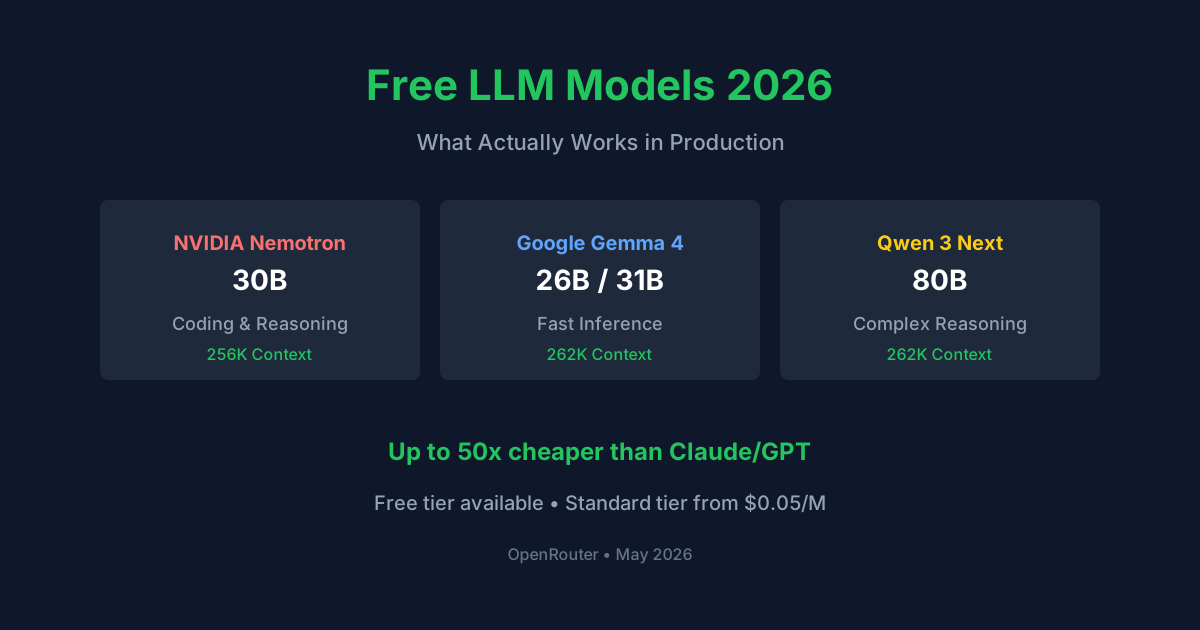
The free LLM tier on OpenRouter is real — NVIDIA Nemotron 3 Nano 30B, Google Gemma 4 26B and 31B, and Qwen 3 Next 80B all have free slots. You can build real things with them at no cost, up to a point.
The free tier works for development, prototyping, and low-volume internal tools. It breaks down when you’re serving real users with latency requirements. At that point, the standard tier pricing kicks in — and even then, you’re paying $0.05-0.13 per million tokens, which is 20-50x less than Claude or GPT-4o.
Each free model has specific strengths, where the limits are, and what to use when you need to scale.
The Free Tier Landscape in May 2026
OpenRouter aggregates models from dozens of providers. The free tier isn’t a single thing — it’s a dynamic allocation where providers offer free usage to attract developers. When the free tier is popular, you share resources with everyone else and response times suffer.
The models currently offering free tiers that matter:
NVIDIA Nemotron 3 Nano Omni 30B A3B Reasoning (Free) Context: 256K. Trained by NVIDIA. Strong on coding and reasoning tasks. The “Omni” variant is optimized for multi-modal reasoning. This is the strongest free reasoning model on the platform.
Google Gemma 4 26B A4B Instruct (Free) Context: 262K. Google’s latest Gemma release. Uses multi-token prediction for faster inference. Better at general tasks than Nemotron but slightly less capable on deep reasoning. Available in both free and paid tiers.
Google Gemma 4 31B (Free) Context: 262K. Same architecture as 26B but with more parameters. Better reasoning, slightly slower. Free tier availability is more constrained than 26B.
Qwen 3 Next 80B A3B Instruct (Free) Context: 262K. Qwen’s flagship open weights model at 80B parameters. Competitive with models twice its size on many benchmarks. The A3B variant uses aggressive quantization to fit more on less hardware.
Qwen 3 Coder (Free) Context: 262K. Purpose-built for code generation. Fine-tuned for completion, refactoring, and code review tasks.
What Each Model Does Well
Nemotron 3 Nano 30B
Nemotron’s sweet spot is tasks that need reasoning but don’t need frontier-level capability. It handles multi-step logic, debugging, and code generation better than Gemma 4 on most benchmarks. It’s been trained by NVIDIA on curated data specifically for these tasks.
Where it struggles: response speed. Reasoning models think longer before outputting tokens. If you’re building an interactive tool where users are waiting on the other end, Nemotron’s latency is noticeable compared to a faster model like Gemma 4 26B.
Practical use cases that work well on Nemotron:
- Debugging assistance (analyzing error traces, suggesting fixes)
- Code review and refactoring suggestions
- Technical documentation generation
- Multi-step problem solving where the path isn’t obvious
Gemma 4 26B/31B
Gemma 4’s advantage is inference speed. The multi-token prediction architecture means it generates tokens faster for the same output length compared to standard decoding. For tasks where you’re generating long responses, this adds up.
The 26B vs 31B tradeoff is straightforward: 26B is faster and cheaper, 31B is more capable. For most general tasks — summarization, Q&A, content generation, straightforward coding — 26B is the better choice.
Practical use cases that work well on Gemma 4:
- Document summarization and extraction
- Content classification and tagging
- Long-context Q&A over documents
- Coding assistance for well-defined tasks
- Interactive chat interfaces where latency matters
Qwen 3 Next 80B
Qwen 3 at 80B sits between the smaller open models and frontier models in capability. It’s better at complex reasoning than Gemma 4 or Nemotron for most tasks, and the 262K context is substantial.
The catch: 80B parameters is large. Even with aggressive quantization, serving it costs more for the provider, which means free tier availability is more volatile. When servers are busy, Qwen 3 free requests get deprioritized first.
Practical use cases that work well on Qwen 3 Next 80B:
- Complex multi-step reasoning
- Long-document analysis and generation
- Code generation for larger, more complex functions
- Tasks that benefit from extended context
- Anything where Gemma 4 31B is close but not quite capable enough
The Free Tier Reality Check
Free tier sounds great until you’re in production and your users complain that responses are taking 45 seconds. Here’s the honest picture.
Development and testing: Free tier is excellent. You can evaluate every model, run hundreds of prompts, test different approaches — all at zero cost. This is what free tier is actually for.
Low-volume internal tools: If you have an internal tool used by 10-20 people making 200-500 requests per day, free tier can work. The traffic is low enough that you’ll usually get fast responses. But when multiple people hit it simultaneously, you’ll notice queuing.
Production user-facing systems: Not viable on free tier. The moment you have real users with real latency expectations, the inconsistency of free tier will fail you. Move to standard tier.
The standard tier costs are still dramatically lower than frontier models:
| Model | Standard Input | Standard Output | Free Tier |
|---|---|---|---|
| Nemotron 3 Nano 30B | $0.05/M | $0.20/M | Yes |
| Gemma 4 26B | $0.06/M | $0.33/M | Yes |
| Gemma 4 31B | $0.13/M | $0.38/M | Yes |
| Qwen 3 Next 80B | $0.09/M | $0.78/M | Yes |
| Qwen 3.5 9B | $0.10/M | $0.15/M | No |
| Qwen 3.5 35B | $0.15/M | $1.00/M | No |
Prices from OpenRouter (May 2026). Verify before making infrastructure decisions.
For context: Claude 3.5 Sonnet is $3.00/M input. Gemma 4 26B at $0.06/M is 50x cheaper.
What to Build With Each One
Use Gemma 4 26B (free or $0.06/M) for:
- Chat interfaces where response speed is noticeable — the multi-token prediction makes it feel snappier
- Document processing pipelines — 262K context means you can fit entire PDFs, legal documents, or codebases in a single call
- High-volume classification — at $0.06/M input, you can classify a million documents for $60
- Summarization at scale — news feeds, customer support tickets, research papers
Use Nemotron 3 Nano 30B (free or $0.05/M) for:
- Code debugging — it reasons through error traces well
- Technical Q&A — anything where multi-step logic matters more than raw speed
- Internal knowledge bases — where accuracy matters more than milliseconds
Use Qwen 3 Next 80B (free tier when available, $0.09/M standard) for:
- Complex reasoning tasks where Gemma 4 isn’t quite capable enough
- Long-document work that needs deeper comprehension
- When you need GPT-4 class results without GPT-4 pricing
Use Qwen 3.5 9B ($0.10/M) when:
- You need the lowest-cost option that still works reliably
- You’re processing high-volume, simple tasks (keyword extraction, tagging, basic classification)
- Budget is the primary constraint and you can tolerate some capability tradeoffs
The Scaling Path
When a free-tier project takes off, here’s what happens:
Week 1: Free tier handles everything. Everything is great. You’re winning.
Week 3: You’re hitting rate limits during business hours. Responses slow to 20-30 seconds. Users notice.
Week 5: You switch to standard tier. Your per-token cost drops to $0.05-0.13/M. You were paying $0 before, so this feels like a shock — but your actual cost for 100,000 requests at $0.06/M input is $6. If those requests were going to Claude at $3.00/M, they’d cost $300.
The math works in your favor even at standard tier. A project that graduates from free tier to standard tier is a project that’s succeeding. The cost per token is still so far below frontier models that most teams don’t notice the line item until they’re processing millions of requests per month.
At millions of requests per month, you’re still paying fractions of what Claude or GPT would cost for equivalent volume.
The Models Worth Knowing Around
Beyond the free tier, a few paid models are worth having in your toolkit for when free tier isn’t enough:
Qwen 3.5 Plus (1M context) — $0.325/M input, $1.95/M output. The 1M token context window is genuinely useful for processing entire codebases, long legal documents, or large research corpora. This is the model to reach for when 262K isn’t enough.
Qwen 3.5 397B — $0.39/M input, $2.34/M output. The largest Qwen model. Closer to frontier-class reasoning for tasks where you genuinely need it. Still 7-10x cheaper than GPT-4o.
Qwen 3 Coder Plus — $0.65/M input, $3.25/M output. The strongest open-weights code model for complex, multi-file code generation tasks.
The Honest Summary
Free LLM models in 2026 are real, useful, and worth using — but not for everything. They work best for development, prototyping, and low-volume internal tools. The moment you have real users with real expectations, standard tier is the answer, and even then you’re paying 20-50x less than frontier models.
The three models to know:
- Gemma 4 26B for fast, cheap general tasks
- Nemotron 3 Nano 30B for coding and reasoning
- Qwen 3 Next 80B for complex tasks that need more capability
Start with the free tier. Move to standard tier when traffic demands it. The economics of open-weights models have changed completely — the barrier to building with AI is lower than it’s ever been.
Go Deeper:
- OpenRouter Pricing Guide 2026 — how to use OpenRouter effectively
- Small Language Models: SLM Cost Guide — when to pick SLMs over free tier
- DeepSeek V3 Cost Analysis — another strong cheap option
- RTX 4090 for Local Development — free vs cloud GPU economics
News & Community:
- HN: NVIDIA Nemotron 3 Nano announcement
- The Decoder: Open weights models 2026
- TechCrunch: Free LLM tier race
Pricing and model availability from OpenRouter (May 2026). Free tier status fluctuates — check OpenRouter for current availability before building. Model capability claims based on published benchmarks and community reports; evaluate with your own workloads before production deployment.
Frequently Asked Questions
What free LLM models are actually available in 2026?
Three models hit free tier on OpenRouter as of May 2026: NVIDIA Nemotron 3 Nano Omni 30B (256K context), Google Gemma 4 26B and 31B (262K context), Qwen 3 Next 80B A3B Instruct, and Qwen 3 Coder. All have free tiers with rate limits that vary by provider demand.
How much can I actually generate with free tier?
Free tier limits are soft and vary by traffic. For development and testing, it's effectively unlimited. For production use, expect rate limits that make free tier useful for under 1,000 requests/day. Beyond that, the standard tier kicks in at $0.05-0.13/M tokens depending on the model.
What's the catch with NVIDIA Nemotron 3 Nano?
Nemotron 3 Nano 30B is trained by NVIDIA on curated data and performs well on coding and reasoning tasks. The free tier works for prototyping. The catch is that it's a reasoning model, so it takes longer to generate responses than a faster model like Gemma 4 26B — and when free tier is congested, response times spike.
Gemma 4 vs Nemotron — which should I start with?
For general tasks: Gemma 4 26B (free) — faster, cheaper at standard tier ($0.06/M input). For coding tasks: Nemotron 3 Nano 30B (free) — stronger on code generation and reasoning benchmarks. Both have 256K+ context windows.
What can Qwen 3 do that Gemma 4 can't?
Qwen 3 has models up to 397B parameters (Qwen 3.5 397B) with 1M token context on smaller variants. Qwen 3.5 Plus supports 1M context at standard pricing. If you need extremely long document processing, Qwen's context window is a significant advantage over Gemma 4's 262K.
Is free tier actually free for commercial use?
OpenRouter's free tier is for development and testing. For commercial production use, you should move to the standard tier. The free tier exists to let you evaluate models before committing — not to run your business on.
What's the cheapest paid model worth using in 2026?
Qwen 3.5 9B at $0.10/M input and $0.15/M output is the best cost-performance ratio for simple, high-volume tasks. Gemma 4 26B at $0.06/M input is the best balance of cost and capability for general tasks. Both are 20-50x cheaper than Claude 3.5 Sonnet.
How do free tier models handle production traffic?
They handle it inconsistently. During peak hours, free tier queues build up and response times go from seconds to tens of seconds. For any production system with user-facing latency requirements, free tier is not viable — standard tier is mandatory.
Which model is best for code generation?
NVIDIA Nemotron 3 Nano 30B is the strongest free option for code tasks. Qwen 3 Coder (free tier available) is purpose-built for code. For serious code generation at scale, Qwen 3.5 35B at $0.15/M input offers the best balance of quality and cost.
What happens when I hit free tier rate limits?
OpenRouter queues your request and retries. If the queue is long, you get a timeout. There's no explicit quota published — limits adjust dynamically based on server load. For production reliability, use the standard tier and budget $0.05-0.15 per million input tokens.
Share this article