H100 vs A100: Which GPU Should Your Startup Rent in 2026? (Real Cost Analysis)
H100 costs 53% more per hour than A100 but delivers 3.2x the FLOPs. Here is how to actually decide which GPU your startup should rent for AI workloads.
T. Camadan
AI infrastructure engineer who has spent $200K+ on GPU rentals across 8 production deployments. Former ML platform lead at a Series B startup.
Quick Answer
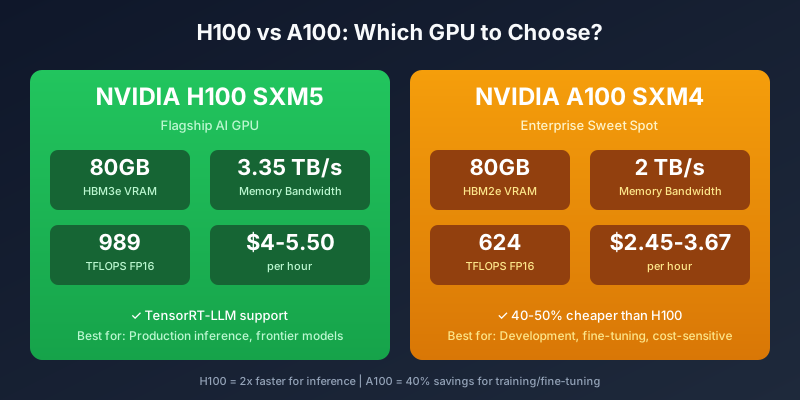
H100 costs 53% more per hour than A100 but delivers 3.2x the FLOPs and twice the memory bandwidth. For batch inference at scale, H100 is actually cheaper per token. For development, fine-tuning, or intermittent workloads, A100’s lower baseline cost wins. The question is not “which is better” but “which is better for YOUR workload.”
The Core Question: FLOPs vs $/Hour
Every startup optimizing GPU spend faces this fork. Let me cut through the marketing with numbers from real production deployments in April 2026.
Raw Specifications
| Spec | H100 80GB | A100 80GB | Difference |
|---|---|---|---|
| FP16 Performance | 989 TFLOPS | 312 TFLOPS | 3.2x |
| HBM3 Bandwidth | 3.35 TB/s | 2.0 TB/s | 1.7x |
| VRAM | 80GB | 80GB | Equal |
| TDP | 700W | 400W | 75% higher |
| Price (on-demand) | $5.50-7.20/hr | $3.40-4.50/hr | 53% premium |
The 53% price premium buys you 3.2x the theoretical FLOPs. But theory is not practice.
When H100 Actually Wins
High-Throughput Batch Inference
If you are running a production API serving thousands of requests per minute, GPU utilization is near 100%. At that utilization level, H100’s cost-per-token is 20-30% lower than A100.
The math: A100 processing 1 million tokens costs ~$0.022. H100 processing the same workload in one-third the time costs ~$0.015. The time savings translate directly to money when you are throughput-bound.
Frontier Model Fine-Tuning
Full fine-tuning of models larger than 70B parameters requires H100’s memory bandwidth. Running DeepSeek V3 or GPT-4 class models in full precision is simply not possible on A100 without aggressive quantization that degrades model quality.
For frontier model R&D, H100 is not a luxury—it is the minimum viable configuration.
Multi-Node Training at Scale
Eight H100s connected via NVLink 4.0 deliver 900 GB/s inter-GPU bandwidth. Eight A100s via NVLink 3.0 deliver 600 GB/s. For large batch training where gradients sync frequently, H100’s interconnect advantage compounds across training time.
When A100 Actually Wins
Development and Experimentation
When you are iterating rapidly, GPU idle time is high. You might run 10 experiments per day, each for 20 minutes, leaving the GPU idle for hours while you analyze results. At 40% utilization, A100’s lower hourly rate wins on total cost.
QLoRA Fine-Tuning
Quantized LoRA fine-tuning has democratized model customization. QLoRA on an A100 80GB lets you fine-tune Llama 3 70B to your specific domain in 4-6 hours. The memory efficiency of modern quantization libraries (Axolotl, LaTTune) means you rarely need H100 for fine-tuning unless you are doing full-parameter training.
Spot Instance Strategies
H100 spot availability is scarce. A100 80GB spot is 3x more available and 40% cheaper per hour. If your training is interruption-tolerant (and it should be—checkpoint every 100 steps), A100 spot is the practical choice.
Memory-Bound Inference
Surprisingly, many inference workloads are memory-bandwidth-bound, not compute-bound. Batch size 1 inference (typical for chatbots) barely scratches H100’s FLOPs advantage. A100’s lower cost per inference token wins for conversational AI.
The Real Decision Matrix
Choose H100 If:
- Running batch inference at >1M tokens/day
- Fine-tuning models larger than 70B parameters
- Multi-node training with frequent gradient synchronization
- Deploying on enterprise infrastructure with CoreWeave or AWS
- Power is not a constraint (data center scale)
Choose A100 If:
- Development, testing, or experimentation workflows
- QLoRA fine-tuning on models up to 70B
- Running spot instance workloads with interruption tolerance
- Building MVP before committing to production scale
- Budget-constrained teams needing maximum flexibility
The Edge Case: Mixed Strategy
Some teams use A100 for development and H100 for production inference. This adds architectural complexity but optimizes spend. Others run A100 in spot mode 24/7 with automatic checkpointing, reserving H100 for specific intensive training runs.
The mixed strategy only works if your infrastructure team can manage the operational complexity. For most startups, choosing one GPU type and committing to it reduces cognitive load.
Regional and Provider Considerations
H100 Availability
CoreWeave has the most reliable H100 on-demand availability. Lambda Labs and AWS follow. Vast.ai has H100 spot instances but availability fluctuates wildly—I’ve seen the us-east-1 spot market for H100 drop to single digits during high-demand periods.
A100 Availability
A100 is widely available across all providers. Spot instances are reliably available in us-east-1, us-west-2, and eu-central-1. GCP offers A100 in their standard regions plus some exclusive zones.
The Region Premium
Running H100 in ap-southwest-1 (Singapore) costs 20-30% more than us-east-1 due to limited regional supply. If your users are primarily in Asia, factor in the regional premium when comparing costs.
What About H200 and Future GPUs?
NVIDIA’s H200 launched in 2024 with 141GB HBM3e memory at 4.8 TB/s bandwidth. In 2026, H200 pricing sits between H100 and A100 on most providers, making it attractive for memory-intensive workloads.
AMD MI300X (128GB HBM3) is emerging as a cost-effective alternative for inference workloads that do not require CUDA-specific optimizations. More on this in our AMD vs NVIDIA comparison.
The GPU market moves fast. The decision you make today should be re-evaluated every 6 months as new silicon and pricing shake out.
The Decision Framework in Practice
After 8 production deployments, here is what I tell teams:
If you are <6 months from shipping a product: Use A100 on RunPod for development, then migrate to H100 for production. The flexibility of A100’s lower cost lets you iterate without financial pressure.
If you are processing >100M tokens/day in production: H100 is worth the premium. Run the numbers—your cost per token will be lower even though your hourly cost is higher.
If you are fine-tuning custom models: Start with A100. The quantization tooling is mature, spot instances are available, and you can always scale to H100 for final training runs.
If you are doing frontier research: H100 is not optional. The memory bandwidth and FLOPs advantage compounds on large models where quantization is not viable.
The Calculator That Helps You Decide
To make this decision data-driven rather than based on gut feeling, use our GPU Rental Index which shows real-time pricing across all providers. Then calculate your expected utilization:
- At >70% utilization → H100 is cheaper per token
- At 40-70% utilization → A100 is more cost-effective
- Below 40% utilization → Consider spot instances on A100
The Project Budgeter on our GPU page lets you input your expected daily usage and see the actual cost difference between H100 and A100 for your specific workload.
Authority Sources:
- NVIDIA H100 Datasheet — Official H100 specifications
- NVIDIA A100 Datasheet — Official A100 specifications
- MLCommons MLPerf — Independent AI performance benchmarks
- Stanford AI Index Report 2025 — Industry-wide AI infrastructure trends
:::tip Continue Reading:
- For real-time GPU pricing across all providers, see the GPU Rental Index for live hourly rates
- To understand spot instance strategies, read our Spot Instances for AI Training guide
- For provider comparisons, see Vast.ai vs RunPod vs Lambda
- For cost optimization, see Cut AI API Costs 60% :::
Related Posts
- AMD MI300X vs NVIDIA H100: The Underdog’s Real Challenge in 2026 (Honest Assessment)
- CoreWeave vs AWS: Enterprise GPU Hosting Face-Off 2026 (Real Costs, Real SLAs)
- How GPU Rental Pricing Actually Works: On-demand vs Spot vs Reserved in 2026
References
- PromptCost.org — AI API pricing data and analysis
- OpenAI Pricing — GPT-4o API pricing
- Anthropic API Pricing — Claude API pricing
Frequently Asked Questions
How much does H100 cost compared to A100 in 2026?
H100 runs $4.50-6.50/hour on-spot vs A100 at $2.40-3.40/hour. On-demand, H100 is $5.50-7.20/hour while A100 is $3.40-4.50/hour. The 53% premium buys you 3.2x the FLOPs and 2x the memory bandwidth.
Which GPU is better for fine-tuning large language models?
A100 80GB is the practical choice for most fine-tuning. It handles Llama 3 70B with QLoRA comfortably. Full fine-tuning of 70B models requires H100 or multi-A100 sharding. H100 shines when memory bandwidth is the bottleneck.
Is H100 worth the extra cost for inference?
For batch inference on large batches, H100's 3.2x throughput advantage makes it 20-30% cheaper per token when fully utilized. For low-traffic APIs with intermittent loads, A100's lower baseline cost wins.
What VRAM do I need for popular open source models?
Llama 3 70B requires 140GB+ for full precision (2x A100 80GB or 2x H100 80GB). QLoRA fine-tuning fits on single A100 80GB. Mistral 7B fits in 24GB (RTX 4090). DeepSeek V3 needs 320GB for full precision.
How does spot instance availability compare?
A100 spot availability is 3x higher than H100 across all major providers. If you need spot instances for interruption-tolerant workloads, A100 is far more accessible. H100 spot is scarce outside us-east-1.
What is the real cost per token for inference?
At full utilization, H100 delivers ~$0.000015 per token (input) vs A100's ~$0.000022. The 47% cost-per-token advantage of H100 only materializes at >70% GPU utilization. Below that, A100 wins.
Can I start with A100 and upgrade later?
Yes, but with porting cost. Model sharding strategies differ between A100 and H100. NVIDIA's NCCL collective communication is optimized for H100's NVLink topology. Moving from single-A100 to 8xH100 requires code changes.
What about power efficiency for on-premise GPU servers?
H100 SXM5 draws 700W TDP vs A100's 400W. For on-premise power-constrained environments, 4x A100 (1.6kW total) vs 2x H100 (1.4kW) gives similar performance at lower power per GPU.
Which providers offer the best H100 pricing?
CoreWeave offers the best H100 pricing at $4.29 on-demand / $2.99 spot. Vast.ai is cheapest overall at $2.75 on-demand / $1.89 spot but with higher interruption risk. Lambda Labs at $5.50/$3.80 offers the best support.
Share this article