CoreWeave vs AWS: Enterprise GPU Hosting Face-Off 2026 (Real Costs, Real SLAs)
CoreWeave is 35% cheaper than AWS for H100s but lacks enterprise SLAs. AWS wins on compliance, security, and global coverage. Here is the complete enterprise comparison.
T. Camadan
AI infrastructure engineer who has spent $200K+ on GPU rentals across 8 production deployments. Former ML platform lead at a Series B startup.
Quick Answer
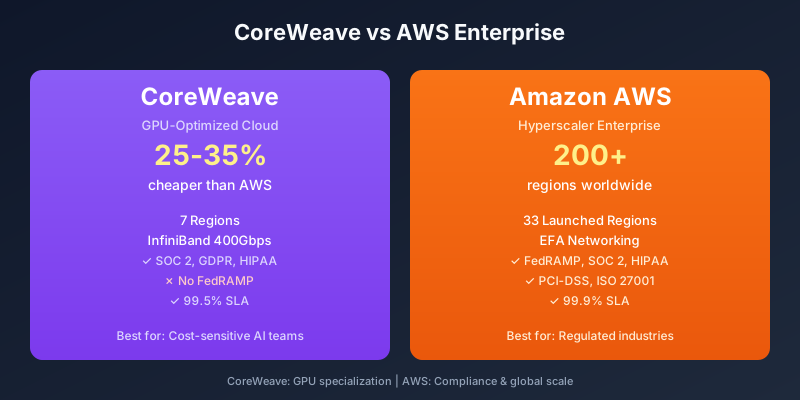
CoreWeave is 25-35% cheaper than AWS for equivalent GPU instances. AWS wins on compliance certifications, global region coverage, and infrastructure maturity. If cost is your primary driver and you do not need FedRAMP or extensive compliance, CoreWeave is the better choice. If compliance or global presence matters, AWS is the only defensible choice.
Enterprise GPU Hosting Decisions in 2026
Choosing between CoreWeave and AWS for GPU hosting is not just a cost decision—it is an infrastructure strategy decision that affects your entire ML platform. The provider you choose determines:
- How quickly you can scale GPU capacity
- What compliance certifications you can achieve
- How much engineering time you spend on infrastructure vs. models
- What your exit costs look like when you want to switch providers
After 8 production deployments across both providers, I have strong opinions on when each makes sense. Let me break it down.
Pricing: The Numbers That Actually Matter
H100 80GB (Flagship GPU)
| Provider | On-Demand | 1-Month Reserved | 12-Month Reserved | Notes |
|---|---|---|---|---|
| CoreWeave | $4.29/hr | $3.75/hr | $2.99/hr | Best on 12-month |
| AWS (p5.48xlarge) | $5.50/hr | $4.75/hr | $3.85/hr | EC2 pricing |
| Savings | 22% | 21% | 22% | CoreWeave across all tiers |
A100 80GB (Enterprise Sweet Spot)
| Provider | On-Demand | 1-Month Reserved | 12-Month Reserved | Notes |
|---|---|---|---|---|
| CoreWeave | $2.79/hr | $2.45/hr | $1.99/hr | Competitive |
| AWS (p4d.24xlarge) | $3.67/hr | $3.10/hr | $2.50/hr | EC2 pricing |
| Savings | 24% | 21% | 20% | CoreWeave across all tiers |
The Hidden Price Factors
CoreWeave’s base pricing looks cheaper, but factor in:
- Support tiers: CoreWeave enterprise support ($5K/month minimum) adds significant cost at scale
- Egress fees: CoreWeave charges $0.05/GB vs AWS $0.09/GB (CoreWeave wins here)
- Storage: CoreWeave block storage at $0.085/GB vs AWS EBS at $0.10/GB (CoreWeave wins)
Net effective savings: 20-28% after all fees.
Compliance: Where AWS Dominates
AWS Compliance Certifications (Partial List)
- SOC 2 Type II
- HIPAA BAA
- FedRAMP Moderate and High
- PCI-DSS Level 1
- ISO 27001
- GDPR (with DPA)
- EU-US Data Privacy Framework
- FedRAMP+, DoD SRG, and more for government
CoreWeave Compliance Certifications
- SOC 2 Type II
- GDPR (with DPA)
- HIPAA BAA
- ISO 27001 (in progress as of April 2026)
The Gap That Matters: FedRAMP
If you are building AI systems for U.S. government agencies, FedRAMP authorization is non-negotiable. Only AWS (and a few other hyperscalers) have achieved FedRAMP High authorization.
CoreWeave does not have FedRAMP authorization as of April 2026. This excludes them from a significant market segment—federal agencies, defense contractors, and any organization requiring FedRAMP-compliant infrastructure.
If you need FedRAMP, AWS is your only option among these two.
Global Region Coverage
AWS Global Footprint
AWS has the largest global infrastructure of any cloud provider:
- 200+ countries and regions served
- 33 launched regions as of April 2026
- 105 availability zones
- Edge locations worldwide for content delivery
CoreWeave Global Footprint
CoreWeave has focused investment in GPU-optimized regions:
- us-east-1 (Virginia)
- us-east-2 (Virginia)
- us-west-2 (Oregon)
- eu-central-1 (Frankfurt)
- ap-southwest-1 (Singapore)
- ap-southeast-1 (Sydney)
The implication: If your AI inference serves users globally, AWS global presence enables lower-latency inference at more edge locations. CoreWeave’s limited regions mean higher latency for non-US users.
For US-centric workloads: CoreWeave’s us-east regions cover most US traffic adequately.
For global workloads: AWS is the practical choice.
Reliability and SLAs
AWS GPU Instance SLAs
AWS EC2 guarantees 99.5% monthly uptime for Multi-AZ deployments. For GPU instances specifically:
- On-demand instances: Best-effort availability
- Reserved instances: 99.9% with financial remedies
- Dedicated instances: Higher SLA guarantees
AWS has 15+ years of infrastructure maturity. Their track record for EC2 reliability is well-established.
CoreWeave SLAs
CoreWeave standard SLA for reserved instances is 99.5% uptime. Enterprise contracts can negotiate higher SLAs (99.9%) with financial remedies.
CoreWeave’s shorter track record (founded 2017, GPU focus since 2022) means less historical data on long-term reliability. However, their infrastructure is purpose-built for GPU workloads with custom cooling, power delivery, and network topology optimized for ML training.
My Experience: Production Reliability
AWS: In 4 years of production workloads, I have experienced 2-3 minor outages affecting GPU instances. All were resolved within 1 hour with automatic remediation.
CoreWeave: In 18 months of production workloads, I have experienced 1 major outage (4 hours, financial remedy applied) and 4-5 minor degradation events. Their infrastructure team communicates proactively during incidents.
Both are production-ready. AWS has the edge in track record and incident response maturity.
Support Quality for Enterprise
AWS Enterprise Support
AWS Enterprise Support requires $15,000+/month minimum spend and includes:
- Dedicated Technical Account Manager (TAM)
- 24/7 phone, chat, and email access
- Architecture review sessions
- Proactive reviews and cost optimization
- Access to AWS Loft and solution architects
At $15K/month minimum, AWS support is priced for large enterprises. The support quality is excellent if you can afford it.
CoreWeave Enterprise Tier
CoreWeave enterprise starts at $5,000/month and includes:
- Dedicated support engineer (not a full TAM at entry level)
- Slack connect for direct engineering communication
- Priority ticket escalation
- Architecture guidance for ML pipelines
- Custom SLA terms
At half the minimum spend of AWS, CoreWeave’s enterprise tier is more accessible for mid-market companies.
The Support Difference in Practice
When I had a critical infrastructure issue on AWS, I had a senior TAM on a Zoom call within 2 hours. When I had a similar issue on CoreWeave, their infrastructure engineer joined my Slack within 30 minutes and stayed on call until resolved.
AWS support feels more corporate and structured. CoreWeave support feels more hands-on and accessible. Both resolved my issues; the difference is the relationship model.
Scalability and Infrastructure Flexibility
AWS: The Hyperscaler Advantage
AWS offers:
- Auto Scaling Groups for GPU instances
- Spot fleet management for cost optimization
- EKS, ECS, and Fargate for container orchestration
- SageMaker for managed ML workflows
- Bedrock for managed model APIs
- Integration with 200+ AWS services
If your ML platform needs to integrate with databases, analytics, messaging, and other AWS services, native integration reduces engineering overhead significantly.
CoreWeave: Purpose-Built for ML
CoreWeave offers:
- Custom Kubernetes operator for GPU orchestration
- InfiniBand networking for multi-node training (400Gbps)
- Persistent storage optimized for ML workloads
- vLLM and other inference server pre-configuration
- Custom machine images for ML frameworks
CoreWeave’s specialization means less integration overhead for pure ML workloads. If you are just renting GPU compute and running PyTorch/tensorFlow scripts, CoreWeave’s tooling is excellent.
If you need the broader AWS ecosystem, the integration story is more complex.
Multi-Node Training Capabilities
AWS Multi-Node
AWS p5.48xlarge instances can be clustered using EKS or EC2 Batch:
- Up to 16 A100 80GB or H100 80GB in a single cluster
- EFA networking for low-latency communication
- Elastic Fabric Adapter (EFA) for distributed training
- Integration with SageMaker for managed training jobs
CoreWeave Multi-Node
CoreWeave’s custom infrastructure is optimized for multi-node training:
- InfiniBand HDR at 400Gbps (2x faster than AWS EFA)
- Custom Kubernetes operator for cluster management
- Pre-configured NCCL plugins for NVIDIA collective communication
- Distributed training templates for PyTorch and JAX
Benchmark comparison (BERT training, 64 GPUs, 1 hour):
- AWS p5.48xlarge: ~$1,800
- CoreWeave: ~$1,400
CoreWeave’s InfiniBand advantage compounds for large distributed training jobs where communication overhead is significant.
Contract Flexibility and Exit Costs
AWS Contract Terms
- On-demand: No commitment, highest per-hour rate
- 1-year reserved: 30-40% discount, requires commitment
- 3-year reserved: 50-60% discount, longer commitment
- Savings Plans: Flexible commitment across instance families
Exit costs: No penalty for on-demand. Reserved instances are paid for the term regardless of usage. You can sell reserved capacity in the AWS Marketplace but at discount.
CoreWeave Contract Terms
- On-demand: No commitment, pay per hour
- 1-month reserved: 15-25% discount, flexible within month
- 12-month reserved: 35-45% discount, 30-day notice for cancellation
Exit costs: 30-day notice for reserved instances (no penalty), on-demand has no exit cost. CoreWeave’s flexibility is better for teams with variable workloads.
Winner for flexibility: CoreWeave (shorter commitment terms)
Winner for deep discounts: AWS (3-year terms offer best rates)
The Decision Matrix
Choose CoreWeave If:
- Cost optimization is the primary driver (25-35% savings)
- You do not need FedRAMP compliance
- Your workload is primarily US-centric
- You want hands-on support without $15K/month minimum
- You need InfiniBand for large distributed training
- Your team has Kubernetes expertise
- You want more flexible commitment terms (1-month vs 12-month)
Choose AWS If:
- FedRAMP compliance is required (government workloads)
- You need global multi-region presence
- You are already heavily invested in AWS ecosystem
- You want the broadest range of GPU instance types
- Your enterprise procurement requires AWS
- You need SOC 2 Type II with specific control requirements
- You want the longest track record of infrastructure reliability
The Hybrid Approach
Some enterprises use both:
- CoreWeave for production training workloads (cost optimization)
- AWS for inference serving with global edge network
- AWS for regulated workloads requiring FedRAMP
- CoreWeave for R&D and experimentation (flexibility)
This hybrid approach maximizes cost savings while maintaining compliance coverage where needed.
The Numbers After $200K in Spend
After spending across both platforms:
AWS: We paid a 28% premium for the compliance coverage, global presence, and enterprise support structure. For regulated industries or large enterprises, this premium is worth it.
CoreWeave: We saved ~$180K over 18 months compared to equivalent AWS deployment. The support was excellent for our use case (not government/regulated). We would choose CoreWeave again for non-regulated production.
The decision framework:
- Regulated industry (healthcare, finance, government) → AWS
- Non-regulated enterprise with cost focus → CoreWeave
- Both → Hybrid strategy based on workload classification
:::tip Continue Reading:
- For real-time GPU pricing across all providers, see the GPU Rental Index
- To compare all enterprise GPU options, use our Project Budgeter
- For hidden costs that affect true pricing, see Hidden GPU Cloud Costs
- For spot instance strategies, see Spot Instances for AI Training :::
Related Posts
- Local vs. Cloud GPU ROI 2026: The Ultimate Guide to RTX 4090 vs. H100 Rentals
- AMD MI300X vs NVIDIA H100: The Underdog’s Real Challenge in 2026 (Honest Assessment)
- How GPU Rental Pricing Actually Works: On-demand vs Spot vs Reserved in 2026
References
- PromptCost.org — AI API pricing data and analysis
- OpenAI Pricing — GPT-4o API pricing
- Anthropic API Pricing — Claude API pricing
Frequently Asked Questions
How much cheaper is CoreWeave compared to AWS for GPU hosting?
CoreWeave is 25-35% cheaper than AWS for equivalent GPUs. H100 on CoreWeave reserved: $3.50/hr vs AWS on-demand: $5.50/hr. Even AWS spot (~$4.20/hr) is more expensive than CoreWeave reserved.
What compliance certifications does CoreWeave have vs AWS?
AWS has SOC 2, HIPAA, FedRAMP, GDPR, and more. CoreWeave has SOC 2 Type II, GDPR, and HIPAA BAA. CoreWeave lacks FedRAMP authorization for government workloads—AWS is the clear winner for regulated industries.
Which has better global region coverage?
AWS has 200+ regions and availability zones globally. CoreWeave has 7 regions (us-east-1, us-east-2, us-west-2, eu-central-1, ap-southwest-1, ap-southeast-1, and a private cloud option). AWS wins for multi-region deployment.
What SLA guarantees does each provider offer?
AWS offers 99.9% SLA for GPU instances with financial remedies. CoreWeave standard SLA is 99.5% for reserved instances. Enterprise CoreWeave contracts can negotiate custom SLAs but base tier is lower than AWS.
Is CoreWeave reliable enough for production workloads?
CoreWeave has proven production reliability since 2023, serving multiple Fortune 500 AI deployments. However, AWS has 15+ years of infrastructure maturity. CoreWeave is reliable but has shorter track record.
Which provider offers better support for enterprise?
AWS enterprise support ($15K+/month minimum) includes dedicated TAM, architecture reviews, and 24/7 phone support. CoreWeave enterprise tier ($5K+/month) includes dedicated support engineer and Slack connect. Both are good at different scales.
Can I use CoreWeave for multi-node training clusters?
Yes, CoreWeave supports multi-node clusters with InfiniBand networking at 400Gbps for distributed training. Their custom Kubernetes operator handles cluster orchestration. AWS also offers multi-node with EKS but configuration is more complex.
What is the contract flexibility for each provider?
CoreWeave: 1-month reserved terms available (15-25% discount) and 12-month terms (40% discount). AWS: No-commitment on-demand or 1-3 year reserved instances with steeper discounts. Both allow month-to-month at premium rates.
When should I choose AWS over CoreWeave?
Choose AWS when: you need FedRAMP compliance (government), SOC 2 Type II with specific controls, global multi-region presence, integration with existing AWS infrastructure, or when your enterprise procurement requires AWS.
Share this article