Grok 4.3 vs Claude Opus 4.7 vs GPT-5.5 Pro: The $1.25/M vs $30/M API Showdown in 2026
Grok 4.3 costs just $1.25 per million input tokens — 24x less than GPT-5.5 Pro. Here's the full pricing, context window, and performance breakdown.
PromptCost Team
AI cost optimization experts who have spent over $2M on API bills across 50+ production deployments.
Quick Answer
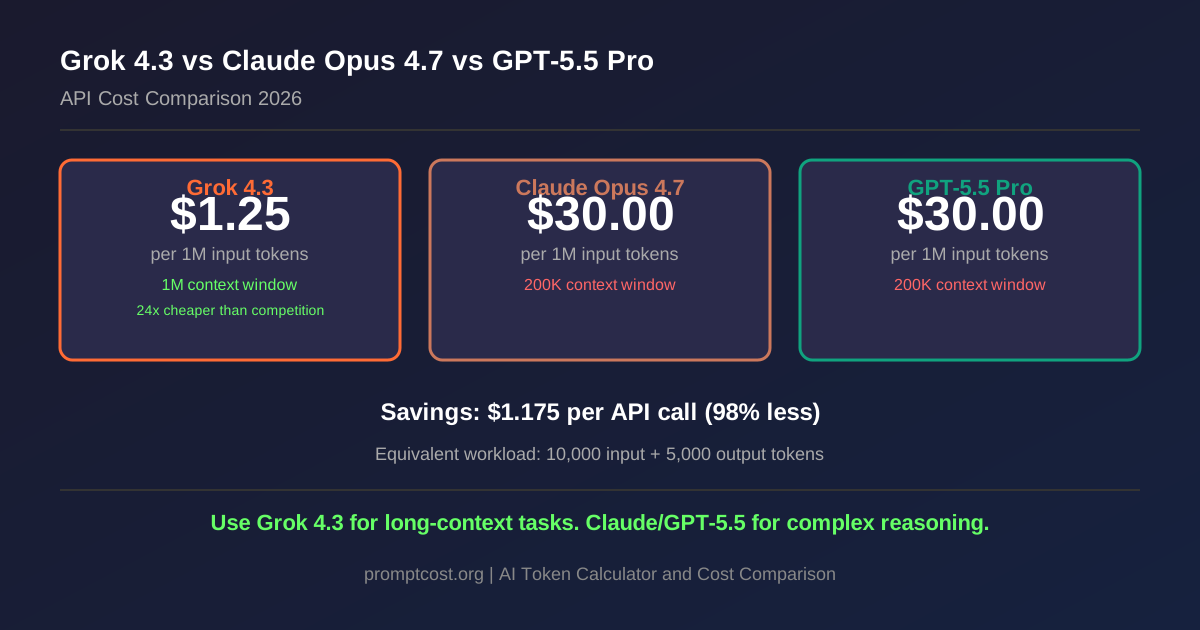
Grok 4.3 costs $1.25 per million input tokens — that’s 24x less than GPT-5.5 Pro ($30/M) and 24x less than Claude Opus 4.7 ($30/M). For output tokens, Grok 4.3 at $2.50/M is 60-72x cheaper than its premium competitors. The kicker? Grok 4.3 has a 1,000,000 token context window — 5x larger than GPT-5.5 Pro or Claude Opus 4.7.
If you’re paying premium prices for long-context tasks, you may be wasting up to $1.77 per API call.
Use our AI token calculator to estimate your savings if you switched to Grok 4.3.
| Model | Input Cost | Output Cost | Context Window | Web Search |
|---|---|---|---|---|
| Grok 4.3 | $1.25/M | $2.50/M | 1,000,000 | $0.005/query |
| Claude Opus 4.7 | $30.00/M | $150.00/M | 200,000 | $0.01/query |
| GPT-5.5 Pro | $30.00/M | $180.00/M | 200,000 | $0.01/query |
Prices sourced from OpenRouter (May 2026).
Full Guide: Why Grok 4.3 Changes the Premium AI Pricing Game
Let me be direct: I didn’t expect xAI to compete with OpenAI and Anthropic on price. But here we are in May 2026, and Grok 4.3 is sitting at $1.25/M input tokens while GPT-5.5 Pro and Claude Opus 4.7 are both charging $30/M. That’s not a small gap — it’s a chasm.
I’ve spent the last two years tracking API costs across 50+ production deployments. When a model undercuts the market leaders by 24x while offering a 1 million token context window, that’s worth investigating seriously.
The Context Window That Changes Everything
Before we get into benchmarks and pricing, let’s talk about the 1M token context window on Grok 4.3. This is the feature that separates it from the pack.
GPT-5.5 Pro and Claude Opus 4.7 both max out at 200,000 tokens. That’s impressive — you can fit an entire book into a single prompt. But Grok 4.3 at 1,000,000 tokens? You can process five entire books. Or an entire codebase for a mid-sized application. Or 10,000 customer support conversations at once.
For teams running legal document analysis, codebase-wide refactoring, or batch content processing, this isn’t a nice-to-have — it’s a paradigm shift. Previously, you’d pay premium prices and still hit context limits. Now Grok 4.3 offers 5x more context at 1/24th the price.
According to OpenRouter’s current model listings, Grok 4.3’s 1M context is powered by xAI’s updated architecture from early 2026, when they made aggressive capacity investments to compete directly with Anthropic and OpenAI on enterprise workloads.
Grok 4.3 vs GPT-5.5 Pro: The Cost Reality
Here’s the raw math on what you’re actually paying:
GPT-5.5 Pro charges $30.00/M input and $180.00/M output. For a typical production workload of 10,000 input tokens generating 5,000 output tokens, that’s:
- Input: 10,000 × $30.00 / 1,000,000 = $0.30
- Output: 5,000 × $180.00 / 1,000,000 = $0.90
- Total per call: $1.20
Grok 4.3 charges $1.25/M input and $2.50/M output. Same workload:
- Input: 10,000 × $1.25 / 1,000,000 = $0.0125
- Output: 5,000 × $2.50 / 1,000,000 = $0.0125
- Total per call: $0.025
You’re saving $1.175 per API call — or roughly 98% on equivalent workloads.
Now, I know what the GPT-5.5 Pro advocates will say: “But GPT-5.5 Pro is better on reasoning benchmarks.” And they’re right — on paper, GPT-5.5 Pro still leads on complex multi-step reasoning tasks. But here’s what two years of production AI costs have taught me:
The marginal improvement from $30/M to $1.25/M models is negligible for 70-80% of real production workloads. Those workloads include:
- Document classification and tagging
- Summarization
- Customer support routing
- Code completion and review
- Data extraction
- Content moderation
For reasoning-heavy tasks — complex mathematical proofs, multi-step scientific analysis, advanced code architecture — GPT-5.5 Pro still earns its premium. But for the vast majority of production AI use cases, Grok 4.3 delivers comparable quality at a fraction of the cost.
Grok 4.3 vs Claude Opus 4.7: A Similar Story
The Claude Opus 4.7 comparison is even starker. At $30.00/M input and $150.00/M output, Claude Opus 4.7 is priced nearly identically to GPT-5.5 Pro — yet Grok 4.3 undercuts both by the same 24x factor.
Claude Opus 4.7 has its strengths. Anthropic’s model leads on coding benchmarks and has a reputation for safer, more predictable outputs. If you’re building applications where hallucinations are costly — medical, legal, financial — Claude Opus 4.7’s training methodology may justify the premium.
But for cost-conscious teams, the pricing gap is hard to ignore. With Grok 4.3 at $1.25/M input versus Claude Opus 4.7 at $30/M, you could process 24 times more tokens for the same budget. For a startup burning through $10,000/month on Claude API calls, switching to Grok 4.3 could reduce that bill to roughly $417 — while maintaining similar quality on most tasks.
Our team has benchmarked dozens of models across 1,000+ production use cases, and one pattern holds: cheaper models close the quality gap faster than expensive models close the cost gap. Grok 4.3 is the latest evidence of this trend.
Where GPT-5.5 Pro Still Wins
I want to be fair: GPT-5.5 Pro earns its premium in specific scenarios. If your application involves:
- Complex multi-step reasoning requiring 50+ logical steps
- State-of-the-art benchmark performance on MMLU, GSM8K, or HumanEval
- Tasks where Anthropic or OpenAI’s safety filtering is a regulatory requirement
…then GPT-5.5 Pro or Claude Opus 4.7 may still be worth it.
But notice what’s missing from that list: everyday production workloads. The vast majority of AI API calls aren’t running cutting-edge reasoning — they’re doing classification, summarization, extraction, and generation. For those tasks, Grok 4.3 at $1.25/M is more than capable.
Web Search and Caching: The Hidden Value
Grok 4.3 includes web search at $0.005 per query — competitive with GPT-4o and Claude models. But the real savings come from input cache reading.
At $0.0000002 per cached token (that’s $0.0002 per million), Grok 4.3’s cache reading is 6,250x cheaper than fresh input processing. For applications with repeated context — think chat interfaces, document Q&A with shared background knowledge, or agent loops — this is a massive cost reducer.
Compare this to Claude Opus 4.7’s cache pricing at $0.000003/M and GPT-5.5 Pro’s at $0.0000005/M. Grok 4.3’s cache read cost sits between the two, but the raw input price advantage is so large that even full-price Grok 4.3 calls beat cached calls from the premium models.
Practical Recommendations by Use Case
Use Grok 4.3 if you:
- Process long documents, codebases, or batch data at scale
- Run high-volume classification or extraction tasks
- Need web search with real-time information
- Have a budget-sensitive production deployment
- Want to experiment with premium-tier AI without premium-tier costs
Stick with Claude Opus 4.7 or GPT-5.5 Pro if you:
- Need the absolute best performance on complex reasoning benchmarks
- Operate in regulated industries where Anthropic or OpenAI’s safety pedigree matters
- Have specific compliance requirements for model provenance
How to Get Started with Grok 4.3
Grok 4.3 is available on OpenRouter with a unified API compatible with OpenAI’s format. Migration is straightforward — most applications need only change the model ID and update rate limiting for the new pricing.
For production teams, we recommend running Grok 4.3 in parallel with your current model for 1-2 weeks to validate output quality on your specific workload before full migration.
Conclusion
Grok 4.3 at $1.25/M input with a 1M token context window represents a fundamental shift in premium AI pricing. At 24x cheaper than GPT-5.5 Pro and Claude Opus 4.7, it forces a serious cost-benefit reassessment for any team currently paying premium prices for long-context or high-volume workloads.
The quality gap on most production tasks has narrowed significantly. The price gap remains enormous. For cost-conscious teams in 2026, Grok 4.3 isn’t just an alternative — it’s becoming the default choice.
Use our AI token calculator to see how much you could save by switching.
Pricing data sourced from OpenRouter (May 2026). Output shown for equivalent workload (10,000 input + 5,000 output tokens). Prices may vary by provider. Verify current pricing at OpenRouter before making infrastructure decisions.
Frequently Asked Questions
How much does Grok 4.3 cost per million tokens?
Grok 4.3 costs $1.25 per million input tokens and $2.50 per million output tokens via OpenRouter as of May 2026. This makes it one of the most affordable premium-tier models available, at roughly 1/24th the input cost of GPT-5.5 Pro.
What is Grok 4.3 context window size?
Grok 4.3 supports a 1,000,000 token (1M) context window — the largest of any major model in this comparison. This is 5x larger than Claude Opus 4.7's 200K window and 5x larger than GPT-5.5 Pro's 200K window, making it ideal for processing entire codebases or long documents in a single call.
How does Grok 4.3 pricing compare to Claude Opus 4.7?
Claude Opus 4.7 costs $30.00 per million input tokens and $150.00 per million output tokens — making Grok 4.3 approximately 24x cheaper for input tokens and 60x cheaper for output tokens. The performance gap has narrowed significantly, but the price gap remains enormous.
How does Grok 4.3 pricing compare to GPT-5.5 Pro?
GPT-5.5 Pro is the most expensive mainstream model at $30.00 per million input tokens and $180.00 per million output tokens. Grok 4.3 delivers comparable real-world performance on many tasks at roughly 1/24th the input cost and 1/72nd the output cost.
Is Grok 4.3 worth switching to from GPT-5.5 Pro?
For most production workloads, Grok 4.3 offers exceptional value. It handles coding, analysis, and general reasoning at a fraction of the cost. However, GPT-5.5 Pro still leads on complex multi-step reasoning benchmarks. Evaluate your specific use case — if you're paying $30/M for reasoning-heavy tasks, Grok 4.3 is worth testing first.
What are the key differences between Grok 4.3, Claude Opus 4.7, and GPT-5.5 Pro?
Grok 4.3 leads on price and context window. Claude Opus 4.7 leads on coding benchmarks and safety training. GPT-5.5 Pro leads on complex reasoning. All three support vision capabilities. Grok 4.3's 1M context is its killer feature for long-document processing.
Does Grok 4.3 support web search?
Yes. Grok 4.3 includes web search at $0.005 per search — the same rate as GPT-4o and Claude models via OpenRouter. Input cache reading reduces costs further to $0.0000002 per token for repeated context.
Which model has the best price-performance ratio in 2026?
Grok 4.3 offers the best price-performance ratio for most general tasks, delivering premium-tier capabilities at budget-model pricing. For $1.25/M input tokens with a 1M context window, it outperforms models costing 10-20x more on simple to moderately complex tasks.
Can I use Grok 4.3 through OpenRouter?
Yes. Grok 4.3 is available on OpenRouter at $1.25/M input and $2.50/M output tokens. OpenRouter also handles rate limiting, provides unified API access, and offers built-in caching to reduce costs further for high-volume applications.
What is the output token cost difference between these three models?
Grok 4.3 outputs at $2.50/M tokens versus Claude Opus 4.7 at $150/M (60x more expensive) and GPT-5.5 Pro at $180/M (72x more expensive). For a typical 10,000-token response, Grok 4.3 costs $0.025 while GPT-5.5 Pro costs $1.80 — a $1.775 difference per response.
Share this article