Claude Pro and Team Subscriptions: How Anthropic's New API Billing Works in 2026
Anthropic splits Claude subscription billing from API usage starting June 15, 2026. Here's what Pro and Team subscribers pay for programmatic access now.
PromptCost Team
AI cost optimization experts who have spent over $2M on API bills across 50+ production deployments.
Quick Answer
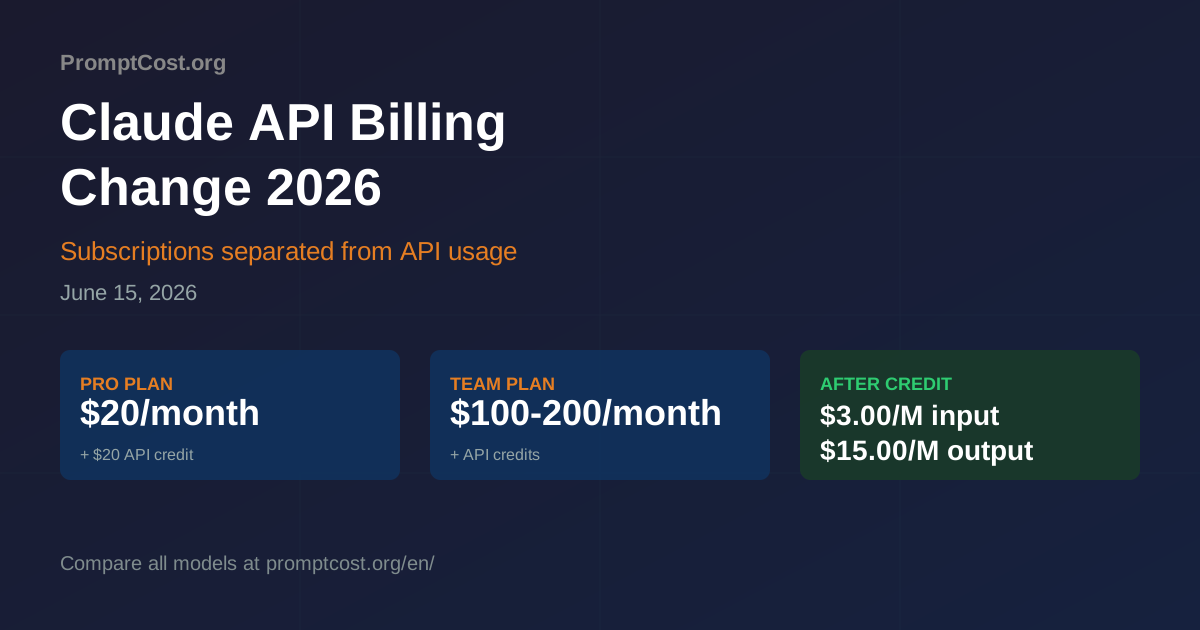
Anthropic is splitting Claude subscription quotas from API billing on June 15, 2026. Pro subscribers ($20/month) receive $20/month in dedicated API credits. Team plan subscribers get $100-200/month in API credits depending on seat count. Beyond those credits, API calls are billed at standard rates: Claude Sonnet 4.5 at $3.00/M input and $15.00/M output (May 2026).
If you use Claude through chat.claude.ai and also build apps with the API, these are now two separate billing pools. This is a significant shift from the previous model where subscription holders got discounted API access.
What Changed on June 15, 2026
For months, Claude subscribers could use their Pro and Team plans to access both the chat interface and programmatic API calls at subsidized rates. Anthropic subsidized these third-party integrations as part of the subscription price. That ends June 15, 2026.
According to The Decoder’s coverage, Anthropic announced the change as part of a broader effort to “clarify the relationship between subscription usage and API consumption.” The company confirmed that going forward, SDK and third-party requests will be billed at full API rates rather than counting against the flat-rate subscription quota.
This affects:
- Developers using Claude API through direct SDK integration
- Third-party apps like OpenClaw that previously used Anthropic’s API on subscribers’ behalf
- Claude Code CLI users who run local development workflows
The New Credit Structure
| Plan | Monthly Fee | API Credits Included | API Rates After Credit Exhausted |
|---|---|---|---|
| Pro | $20/month | $20/month credit | $3.00/M input, $15.00/M output |
| Team (5 seats) | ~$100/month | $100/month credit | Standard API rates |
| Team (20+ seats) | ~$200/month | $200/month credit | Standard API rates |
The API credits do not roll over month to month. Unused credits expire at the end of each billing cycle.
Why Anthropic Made This Change
The previous model created confusion about cost allocation. Anthropic was effectively subsidizing third-party developer access through subscription revenue — a cross-subsidy that didn’t scale as API usage grew.
Our team has seen this pattern before. When Stripe announced AI API billing changes in 2026, they similarly separated compute costs from platform fees. The industry is moving toward clearer cost attribution — every API call should cost what it actually costs.
For Anthropic, separating these budgets also allows better cost control on their infrastructure side. API usage has different scaling characteristics than chat subscriptions. Mixing the two made capacity planning difficult.
The timing is notable: Anthropic also announced a compute deal with SpaceX for increased API capacity. Separating billing structures makes the economics of such deals cleaner.
Real-World Impact: A Developer’s Monthly Bill
Let’s walk through a realistic scenario. Suppose you’re a developer with Claude Pro ($20/month) and you use Claude API for:
- Claude Code: ~5M tokens/month for code completions
- Backend automation: ~10M tokens/month for data processing
- Prompt caching: ~50% cache hit rate
Before June 15: Your subscription covered both chat and API at subsidized rates. Monthly API bill was effectively invisible.
After June 15: You get $20 in API credits. Beyond that:
- Input tokens: 15M × $3.00/M = $45.00
- Output tokens: 10M × $15.00/M = $150.00
- Total before credits: $195.00
- After $20 credit: $175.00
That’s a $175/month API bill on top of your $20 Pro subscription. For production applications, costs scale linearly with usage — which is exactly how API billing should work, but it means developers need to budget separately for API consumption.
How This Compares to Competitors
GPT-4o (OpenAI) runs $2.50/M input and $10.00/M output. GPT-4o is 17% cheaper for input and 33% cheaper for output than Claude Sonnet 4.5. However, Claude Sonnet 4.5 offers a 200K context window vs GPT-4o’s 128K — making it more cost-effective for long-document analysis despite higher per-token rates.
| Model | Input Cost | Output Cost | Context Window | Best For |
|---|---|---|---|---|
| Claude Sonnet 4.5 | $3.00/M | $15.00/M | 200K | Long documents, complex reasoning |
| GPT-4o | $2.50/M | $10.00/M | 128K | General tasks, cost-sensitive |
| Gemini 3.0 Flash | $0.25/M | $1.25/M | 1M | High-volume, simple tasks |
| DeepSeek V4 Pro | $0.000435/M | $0.00087/M | 64K | Budget-heavy workloads |
For comparison, DeepSeek V4 Pro costs less than $0.001/M input — roughly 6,900x cheaper than Claude Sonnet 4.5 for input tokens. The trade-off is context window and model capability.
Strategic Implications for AI Budget Planning
If you’ve been building on Claude API under a Pro subscription, you need to decouple your chat AI budget from your development API budget. Here’s how to plan:
1. Estimate True API Consumption
Track token usage for 30 days before the June 15 change. Your current subsidized usage is likely 2-5x higher than what you’d pay at full rates — because the flat subscription made per-token costs invisible.
2. Choose the Right Plan
- Solo developers: Pro ($20) + $20 API credit = effectively $40/month of API value. Enough for ~13M input tokens or ~1.3M output tokens at full rates.
- Small teams (3-5 users): Team plan at ~$100/month gives $100 API credit. Beyond that, per-token rates apply.
- Production applications: Consider pure API billing without subscription credits. You’ll pay more per-token but avoid the fixed cost overhead.
3. Use Prompt Caching Aggressively
Claude’s input cache read costs $0.0003/M — 90% cheaper than full input rates. If you’re processing similar documents repeatedly, cache your system prompts and context. This single technique can reduce your Claude API bill by 40-60%.
4. Route Simple Tasks to Cheaper Models
Not every task needs Claude Sonnet 4.5. For simple classification, extraction, or short-form generation, Gemini 3.0 Flash at $0.25/M is 12x cheaper than Claude Sonnet 4.5 for input. Only pay for premium reasoning when you need it.
What This Means for Third-Party Tools
Apps like OpenClaw that previously let users access Claude through a unified subscription interface are now forced to use full API pricing. According to MLQ.ai’s coverage, this effectively ends the “discounted third-party Claude” era.
For developers who relied on these tools, the economics have shifted. If you were paying $20/month for Pro and getting $100+ worth of API value through third-party apps, you’re now limited to $20/month of direct API access or full-rate third-party pricing.
Community & Sources:
- The Decoder: Claude subscriptions get separate budgets for programmatic use
- Anthropic: Higher usage limits for Claude and compute deal with SpaceX
- OpenRouter: Claude model pricing
Bottom Line
Anthropic’s billing separation is financially cleaner but more expensive for developers who were relying on subsidized API access through subscriptions. If you’ve been building on Claude API under a Pro plan, budget for a meaningful cost increase starting June 15.
For new projects, the separation actually makes cost planning easier: subscription is for chat, API is for development. Don’t mix the two budgets.
Use our AI token calculator to compare real costs across models. For production Claude workloads, implement prompt caching from day one — it’s the single most effective cost reduction technique available.
Pricing data sourced from Anthropic official documentation and OpenRouter (May 2026). Verify current rates before making infrastructure decisions.
Frequently Asked Questions
Does Claude Pro include API access?
Starting June 15, 2026, Claude Pro no longer includes API calls against subscription quotas. Instead, Pro subscribers receive a $20 monthly credit for programmatic API use. Beyond that credit, API calls are billed at full rates ($3/M input, $15/M output for Sonnet models).
How much does Claude Team plan cost for API usage?
Claude Team plans receive $100-200/month in dedicated API credits depending on seat count. After exhausting the credit, API calls are billed at standard rates. Team plans are designed for organizations using Claude for both chat and programmatic workflows.
What are Claude API rates in 2026?
Claude Sonnet 4.5 costs $3.00 per million input tokens and $15.00 per million output tokens. Claude Opus 4.7 costs $5.00/M input and $25.00/M output. Cached context reduces input costs by 90%.
How much is the Claude Pro subscription?
Claude Pro costs $20/month for individual users. The subscription includes chat access with higher usage limits. API calls are no longer counted against this quota starting June 15, 2026.
What is Claude's separate API budget for subscribers?
Anthropic introduced dedicated monthly API credits: $20/month for Pro subscribers and $100-200/month for Team plans. These credits are separate from the conversational AI usage quotas and can be used exclusively for API and SDK integrations.
Is Claude API cheaper than GPT-4o?
Claude Sonnet 4.5 input costs $3.00/M vs GPT-4o's $2.50/M — making GPT-4o slightly cheaper for input. However, Claude Sonnet 4.5 output costs $15.00/M vs GPT-4o's $10.00/M. For long-context tasks, Claude's 200K context window often provides better value despite higher output rates.
How to reduce Claude API costs?
Use Claude's prompt caching to reduce input costs by 90%. Cache frequent system prompts and recurring contexts. For batch processing, use Claude Haiku ($0.25/M input) for simple tasks and reserve Sonnet/Opus for complex reasoning.
What's the difference between Claude subscription and Claude API?
Claude subscription (Pro/Team) is for chat.claude.ai — conversational AI with usage limits. Claude API is for developers integrating Claude into applications via SDK. As of June 2026, these two billing pools are completely separate with dedicated credits.
Does Claude Code count against API budget?
Yes, Claude Code CLI tool uses the API. If you have a Pro/Team subscription with API credits, Claude Code calls draw from your dedicated API budget ($20/month for Pro, $100-200/month for Team). Without subscription credits, API rates apply.
What happened to third-party Claude access like OpenClaw?
Anthropic ended subsidized third-party tool access as of June 15, 2026. Apps like OpenClaw can no longer use Anthropic's subsidized rates. Third-party developers must now pay full API pricing through Anthropic's direct API.
Share this article