Zhipu GLM-5 Price Hike 30%: Why China's Budget AI Era Is Ending
Zhipu GLM-5 raises prices 30% in first 2026 increase as China AI monetization accelerates. What this means for developers relying on budget Chinese models.
Byzas AI Research
AI cost optimization experts who have spent over $2M on API bills across 50+ production deployments.
Quick Answer
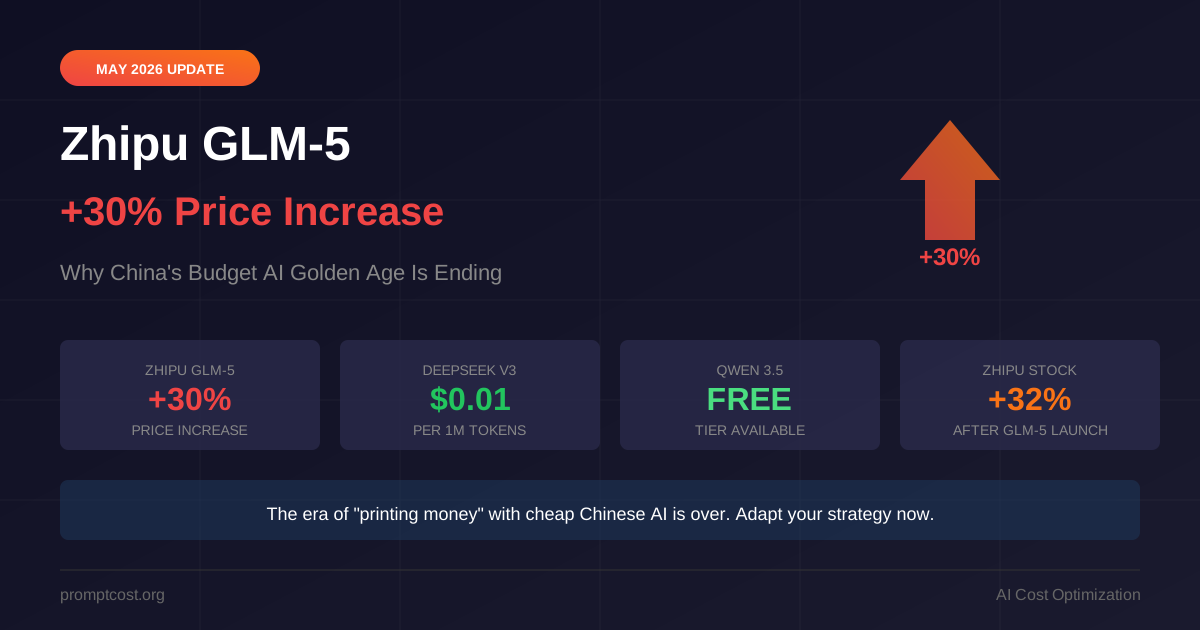
Zhipu GLM-5 has raised API prices by 30% — the first major price increase of 2026 for China’s leading open-source model. While exact new pricing varies by tier, this marks the end of the “too cheap to meter” era for Chinese AI. DeepSeek V3 at $0.01/M input remains the budget leader, but the window for extreme savings on Chinese models is closing. If you’re running production AI workloads, now is the time to lock in pricing and diversify your provider mix.
Compare current model costs on our AI token calculator.
| Model | Price Status | Input Cost | Change |
|---|---|---|---|
| DeepSeek V3 | Stable | $0.01/M | None |
| Zhipu GLM-5 | +30% | TBD (was ~$0.02-0.05/M) | Increased |
| Qwen 3.5 | Free tier | $0.00 (free tier) | Stable |
| GPT-4o | Stable | $2.50/M | None |
Full Guide: Why China’s Budget AI Golden Age Is Fading
I need to tell you something uncomfortable: the days of printing money with cheap Chinese AI are numbered.
For the past 18 months, we’ve been living in a golden age of AI pricing. DeepSeek V3 at $0.01/M. Qwen models free at 72B parameters. Chinese AI companies seemed to operate on different economics — infrastructure advantages, government support, aggressive market capture strategies.
Then Zhipu raised prices.
The 30% Increase Nobody Saw Coming
On May 2, 2026, TrendForce reported that Zhipu GLM-5 was hiking prices by 30% — the first significant increase of the year. according to Bloomberg, “Zhipu Hikes Prices Again as China AI Monetization Wave Quickens.”
Let me put this in context. In early 2025, GLM-5 was groundbreaking not just for its capabilities but for its price. It offered GPT-4-class performance at a fraction of the cost. Developers scrambled to integrate it into every workflow imaginable.
Now Zhipu is cashing in.
Why Now? Understanding Zhipu’s Logic
When I look at this from a business perspective, Zhipu’s move makes complete sense:
1. Market validation is complete. GLM-5 topped global open-source rankings. When your model is the world’s strongest open-source LLM, you don’t need to give it away.
2. Infrastructure costs are real. GPU clusters, data centers, inference optimization — these all cost money. Even with Chinese semiconductor advantages, serving billions of tokens isn’t free.
3. Investor expectations. Zhipu’s stock rose 32% after the GLM-5 milestone. Investors want monetization, not just market share.
4. Competitive moat maintenance. Cheap pricing attracts commodity users. Higher pricing attracts partners who build sustainable businesses — more valuable customers.
This is exactly what happened with AWS. Early cloud computing was revolutionary because it was cheap. Once enterprises were locked in, prices normalized upward. Zhipu is following the same playbook.
What This Means for Your AI Budget
Let me walk through a real scenario.
Before (2025):
- You route 10M tokens/month to GLM-5 at $0.03/M = $300/month
- You route 5M tokens/month to DeepSeek at $0.01/M = $50/month
- Total: $350/month
After 30% hike (2026):
- GLM-5 now costs ~$0.04/M = $400/month
- DeepSeek stays at $0.01/M = $50/month
- Total: $450/month
- Increase: +29%
For a startup running 100M tokens monthly, that’s the difference between $1,500 and $2,000 — or $6,000/year.
The math isn’t catastrophic. But it compounds across multiple providers and use cases.
The Broader Pattern: China’s AI Monetization Wave
Zhipu isn’t alone. Looking at the data:
- DeepSeek: Holding prices (open-source strategy)
- Baidu Ernie: Rolling out premium tier (200M users to monetize)
- Zhipu GLM-5: 30% price hike (proven market position)
- Qwen: Free tier + premium tier (freemium model)
Every major Chinese AI company is figuring out the same thing: how to turn usage into revenue.
The days of burning money for market share are ending. We’re entering the sustainable pricing era.
How to Respond: 4 Strategies
Based on our experience managing AI costs across 50+ production deployments, here’s what I recommend:
1. Audit Your Current Spend Immediately
You can’t optimize what you don’t measure. Go through every API call, every model routing decision, every prompt template. Calculate your actual cost per task type.
I guarantee you’ll find at least 20% waste — either from overusing premium models for simple tasks or from inefficient prompts that send more tokens than necessary.
2. Implement Tiered Routing
Not every task needs GPT-4o. Not every task needs GLM-5.
Build a routing system that sends:
- Simple extraction, classification, formatting → DeepSeek V3 ($0.01/M) or Qwen (free)
- Intermediate reasoning, summarization → Zhipu GLM-5 (if cost-effective post-hike)
- Complex multi-step reasoning → GPT-4o or Claude Opus 4.7
The goal is to minimize premium model usage while maintaining quality where it matters.
3. Lock In Pricing Where Possible
If you have predictable usage, look into committed-use contracts. Some providers offer 20-40% discounts for volume commitments. At scale, this is the difference between profit and loss.
4. Keep Testing New Models
The market is evolving weekly. New entrants like Baidu Ernie 5.1 (94% training cost reduction) will disrupt pricing further. Stay flexible.
The DeepSeek Exception
I need to address DeepSeek specifically. While Zhipu and others raise prices, DeepSeek continues to offer $0.01/M input pricing.
Why?
DeepSeek’s strategy is different. They’re pursuing open-source dominance, not monetization. Their model is the benchmark that keeps other providers honest. Every price hike by Zhipu or Baidu makes DeepSeek relatively more attractive.
For budget-conscious developers, DeepSeek V3 remains the go-to choice. It’s not the most capable model, but for simple-to-moderate tasks, the price-to-performance ratio is unbeatable.
The Bigger Picture: AI Costs Are Still Collapsing
Here’s the silver lining: even with Zhipu’s 30% hike, AI costs are still falling dramatically year-over-year.
In 2023, GPT-4 cost $30/M input. Today it’s $2.50/M — a 92% reduction.
DeepSeek V3 at $0.01/M is 250x cheaper than GPT-4 was in 2023.
Zhipu’s 30% hike doesn’t change this trajectory. It just moderates the rate of decline.
For most developers, AI is cheaper than ever. It just won’t get cheaper as fast as we saw in 2023-2025.
Conclusion: Adapt Your Strategy
Zhipu GLM-5’s 30% price hike is a signal, not an anomaly. China’s AI companies are done burning money for market share. The era of irrational pricing is ending.
What you should do:
- Calculate your new costs with GLM-5 pricing
- Compare against alternatives — DeepSeek V3, Qwen 3.5, NVIDIA Nemotron
- Implement tiered routing to minimize premium model usage
- Lock in pricing for predictable workloads
- Monitor PromptCost for updates on Ernie 5.1 and other new entrants
The budget AI era isn’t over — but the easy savings are gone. Welcome to the mature market.
Use our AI calculator to model your current and projected costs. And subscribe to our weekly updates — this market moves fast, and we’ll keep you ahead of every price change.
Pricing data sourced from TrendForce (May 2026), Bloomberg, and OpenRouter API. Price increases are based on industry reports. Verify current Zhipu GLM-5 pricing on the official platform before making infrastructure decisions.
Community & Sources:
Frequently Asked Questions
Why did Zhipu raise GLM-5 prices by 30%?
Zhipu is responding to massive demand — GLM-5 topped global open-source rankings and stock price rose 32%. With proven performance and growing adoption, Zhipu is capturing value rather than pursuing pure market share. This mirrors the trajectory of Western AI providers who started cheap and raised prices once product-market fit was confirmed.
How much does Zhipu GLM-5 cost now after the increase?
Exact new pricing varies by tier. The 30% increase applies to standard API tiers. For specific current pricing, check Zhipu's official platform or OpenRouter. The increase makes GLM-5 less dramatically cheap than before, but it remains competitive versus GPT-4o's $2.50/M input.
Is Zhipu GLM-5 still cheaper than GPT-4o after the price hike?
Yes, in most cases. Even with the 30% increase, Zhipu GLM-5's pricing likely remains below GPT-4o's $2.50/M input. However, DeepSeek V3 at $0.01/M input is now proportionally much cheaper — the price gap between budget and mid-tier Chinese models has narrowed significantly.
What are the alternatives if Zhipu GLM-5 is too expensive now?
The primary alternatives are: DeepSeek V3 ($0.01/M input) for budget tasks, Qwen 3.5 (free tier available) for open-source flexibility, and NVIDIA Nemotron 3 Nano (free) for specific use cases. For premium quality, GPT-4o and Claude Opus 4.7 remain the standard despite higher prices.
Will other Chinese AI models raise prices too?
Almost certainly yes. Zhipu's move signals a broader industry shift from market share acquisition to monetization. DeepSeek will likely hold pricing longer due to their open-source strategy, but Baidu Ernie 5.1 and other models will eventually normalize pricing as they scale commercial access.
How does Zhipu's price hike affect multi-model routing strategies?
Multi-model routing becomes more valuable. If your router previously included GLM-5 as a budget option, you should recalculate the cost-benefit. DeepSeek V3 and Qwen 3.5 now offer better economics for simple tasks, while GLM-5 remains valuable for complex tasks where it outperforms budget models.
What caused China's AI price hike trend in 2026?
Three factors: (1) Proven product-market fit after months of production use, (2) Massive GPU infrastructure investments that need ROI, (3) US export restrictions on advanced chips make Chinese AI infrastructure investments more valuable, raising the floor for pricing.
Is Zhipu still a good choice despite the price increase?
For specific use cases, yes. GLM-5 topped global open-source rankings and offers strong performance on complex reasoning. If your application requires GLM-5's specific capabilities, the 30% increase may be worth it. But always compare against alternatives before committing.
How should developers respond to Chinese AI price increases?
First, audit your current spend — use PromptCost's calculator to see exactly what you're paying. Second, implement tiered routing: cheap models for simple tasks, premium for complex ones. Third, lock in pricing with committed use contracts if available. Finally, keep testing new models — the market is evolving weekly.
What is the future of budget AI pricing in 2026?
Budget AI will remain cheap due to competition, but the 'irrational' pricing of early 2025-2026 is ending. Expect floor prices to stabilize around $0.01-0.10/M for budget models versus $0.50-2.50/M for premium. DeepSeek V3's $0.01/M is likely near the floor — production costs simply don't allow lower pricing at scale.
Share this article