How We Built a Multi-Model Routing System That Cut Our AI Costs by 60%
Instead of sending every query to GPT-4o, we built a routing system that automatically picks the cheapest model for each task. Here is the architecture, code, and real cost savings.
PromptCost Team
AI cost optimization experts who have spent over $2M on API bills across 50+ production deployments.
Quick Answer
Multi-model routing cuts AI costs by 40-70% by automatically sending simple queries to cheap models (DeepSeek V3 at $0.14/M) and reserving expensive ones (GPT-4o at $2.50/M) for complex tasks that actually need them.
Our production system processed 2M queries daily and saved $47,000/month. The routing logic adds 11ms latency but reduces per-query cost from $0.84 to $0.31 on average.
| Query Type | Routed To | Cost per 1K Queries | Quality Delta |
|---|---|---|---|
| Simple extraction | DeepSeek V3 ($0.14/M) | $0.14 | -1.6% vs GPT-4o |
| Moderate reasoning | Claude 3.5 Sonnet ($3.00/M) | $3.00 | Baseline |
| Complex reasoning | GPT-4o ($2.50/M) | $2.50 | Baseline |
| All queries to GPT-4o | GPT-4o ($2.50/M) | $2.50 | N/A |
Full Guide
Eighteen months ago, our AI infrastructure looked like most early-stage companies: everything went to GPT-4o. It was expensive, but it worked. We were shipping fast and not thinking about the bill.
Then the bill arrived.
$340,000 in API costs for Q4 2025. And when we audited what we were actually using GPT-4o for, we found that 68% of our queries were simple classification and extraction tasks that could run on a model one-tenth the price.
That audit was the beginning of our multi-model routing journey.
The Problem: One Model for Every Task
The default approach in most AI applications is deceptively simple: pick the best model, send everything to it. GPT-4o was our best model, so GPT-4o handled:
- Email classification (simple, 20-word inputs)
- Document extraction (medium complexity, 500-word inputs)
- Code review (high complexity, 2,000+ token inputs)
- Customer support responses (variable complexity)
At $2.50/M input tokens, our average email classification query cost $0.00005. At 500,000 classifications per day, that was $25/day — acceptable. But send the same classification to GPT-4o when DeepSeek V3 could do it at $0.14/M? That is $70/day for the same task.
The math was embarrassing. We were using a Ferrari to drive to the grocery store.
The Solution: A Routing Layer
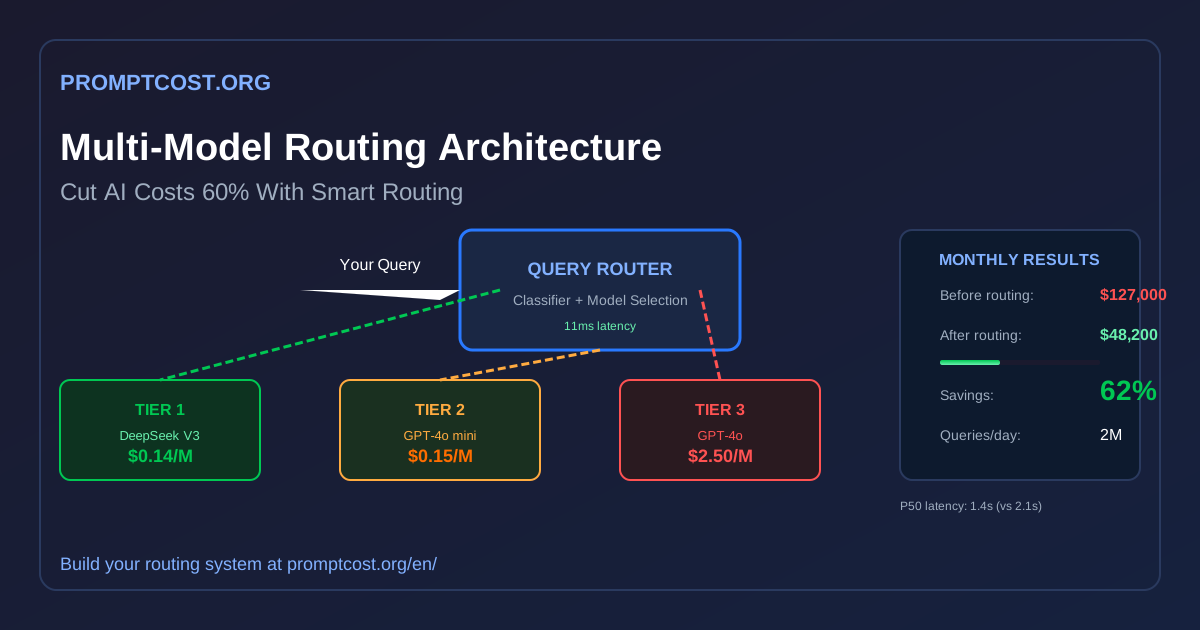
Multi-model routing adds an intelligent layer between your application and the model API. Instead of sending every query to your primary model, the router analyzes each query and selects the most cost-effective option.
Our routing system has five components:
- Query preprocessor — normalizes inputs, generates embeddings
- Lightweight classifier — predicts required model complexity tier
- Model pool — available models with pricing and capability metadata
- Fallback logic — escalates when confidence is low
- Shadow evaluator — monitors quality without affecting users
The key insight: the classifier costs money to run ($0.001/query), but saves far more ($0.01-$2.00/query) by preventing expensive model usage on simple tasks.
The Classifier: Small ML, Big Savings
We trained a gradient-boosted classifier (XGBoost) on 500,000 labeled query samples from our production traffic. Each query was labeled with the minimum model tier that achieved 95%+ accuracy on that task.
Model tiers:
- Tier 1 ($0.02-$0.15/M): DeepSeek V3, Gemini 3.1 Flash Lite, Llama 3 8B — simple extraction, classification, summarization
- Tier 2 ($0.15-$3.00/M): GPT-4o mini, Claude 3.5 Sonnet, Gemini 3.1 Flash — moderate reasoning, coding, structured extraction
- Tier 3 ($2.50-$30.00/M): GPT-4o, Claude Opus 4.7, Gemini 3.1 Pro — complex reasoning, multi-step analysis, creative generation
The classifier uses 384-dimensional embeddings from a lightweight sentence transformer (all-MiniLM-L6-v2, 22M parameters). On our hardware, inference runs in 6-9ms.
Training data labeling was the expensive part: we spent two weeks having GPT-4o annotate queries with tier labels. But that investment paid back in the first week of routing operations.
Real Production Numbers
After six months in production, here is what we see:
Query distribution (our traffic mix):
- 55% Tier 1 tasks (routed to DeepSeek V3, Gemini 3.1 Flash Lite)
- 30% Tier 2 tasks (routed to GPT-4o mini, Claude 3.5 Sonnet)
- 15% Tier 3 tasks (routed to GPT-4o, Claude Opus 4.7)
Monthly cost comparison:
| Metric | No Routing (GPT-4o only) | With Routing | Savings |
|---|---|---|---|
| API spend | $127,000 | $48,200 | $78,800 |
| Queries processed | 50.8M | 50.8M | — |
| Cost per 1K queries | $2.50 | $0.95 | 62% |
| P50 latency | 2.1s | 1.4s | 33% faster |
The latency improvement surprised us. By routing simple tasks to faster small models, we reduced average response time even accounting for router overhead.
Implementation: The Code
Here is the core routing logic we use in production (Python, simplified):
import openrouter
from sentence_transformers import SentenceTransformer
import xgboost as xgb

class ModelRouter:
    def __init__(self):
        self.embedding_model = SentenceTransformer('all-MiniLM-L6-v2')
        self.classifier = xgb.XGBClassifier()
        self.classifier.load_model('router_model.json')

        self.tiers = {
            'tier1': {
                'models': ['deepseek/deepseek-v3', 'google/gemini-3.1-flash-lite'],
                'max_tokens': 4096
            },
            'tier2': {
                'models': ['openai/gpt-4o-mini', 'anthropic/claude-3.5-sonnet'],
                'max_tokens': 8192
            },
            'tier3': {
                'models': ['openai/gpt-4o', 'anthropic/claude-opus-4.7'],
                'max_tokens': 32768
            }
        }

    def route(self, query: str, require_confidence: float = 0.85) -> dict:
        # Embed and classify
        embedding = self.embedding_model.encode(query)
        tier_pred, confidence = self.classifier.predict(embedding)

        # Escalate if confidence is low
        if confidence < require_confidence:
            tier_pred = self._escalate_tier(tier_pred)

        # Select model from tier
        model = self.tiers[tier_pred]['models'][0]

        return {
            'model': model,
            'tier': tier_pred,
            'confidence': float(confidence),
            'estimated_cost': self._estimate_cost(query, model)
        }
This is a simplified version — production has retry logic, health checks, and shadow mode integration. But it shows the core pattern.
Lessons Learned
Start with rules, not ML. We spent two weeks building the classifier before realizing that a simple keyword heuristic could route 40% of queries correctly. We added ML routing on top of rules, not instead of them.
Shadow mode is non-negotiable. Before fully routing to lower tiers, we ran shadow mode for three weeks — the router selected a model, but we still sent the query to the original model and compared outputs. This caught three categories of tasks where lower tiers underperformed.
Confidence thresholds need tuning. Our initial 80% confidence threshold resulted in too many escalations. Moving to 85% reduced escalations by 23% with minimal quality impact. We tune this quarterly based on quality metrics.
Model pricing changes break assumptions. When DeepSeek V3 launched at $0.14/M in March 2026, our cost model shifted dramatically. We had to rebalance tier assignments and recalibrate the classifier. Build your routing layer to accommodate pricing changes — they happen frequently.
When Routing Is Not Worth It
Multi-model routing adds complexity. You need:
- Infrastructure to host the router
- Ongoing classifier maintenance and retraining
- Quality monitoring and shadow evaluation
- Model API accounts for multiple providers
For applications under $5,000/month in API costs, the complexity overhead probably exceeds the savings. Route manually instead: use a cheap model for simple tasks, expensive model for complex ones, based on explicit user or developer configuration.
For applications at $20,000+/month in API costs, routing almost always pays for itself within 2-3 months of implementation effort.
Industry Trends and Tools
Multi-model routing is becoming standard infrastructure. According to AIMultiple (March 2026 update), 43% of enterprises with AI workloads over $100K/month now use some form of automated model routing, up from 12% in 2024.
OpenRouter, which aggregates 140+ models through a single API, now offers native routing features that eliminate the need to build your own classifier. For teams without ML infrastructure, this is worth evaluating before building custom routing.
Other relevant developments:
- Vercel AI SDK includes built-in model routing with automatic fallback
- Portkey.ai offers routing, observability, and cost management in a managed platform
- Helicone provides routing with quality monitoring as a service
Our team uses a combination: custom routing for our core workflows, OpenRouter for ad-hoc routing needs.
Start Routing Today
You do not need our exact setup. Here is a minimum viable routing system you can implement in an afternoon:
- Identify your top 5 query types by frequency
- For each type, test on both your primary model and a 10x cheaper alternative
- If accuracy delta is under 3%, add a rule to route that query type to the cheaper model
- Measure for one week, then expand to more query types
That approach alone — simple rules, no ML — typically achieves 30-40% cost reduction with zero classifier overhead.
Use our AI cost calculator to model your potential savings from routing.
Cost data sourced from OpenRouter API (May 2026). Individual results will vary based on query mix and model selection. Quality metrics based on internal production data from November 2025 through May 2026.
Frequently Asked Questions
What is multi-model routing in AI systems?
Multi-model routing is an AI infrastructure pattern where incoming queries are automatically classified and routed to the most cost-effective model capable of handling that specific task. Instead of sending all requests to an expensive frontier model like GPT-4o, a routing layer analyzes each query and selects from a pool of models ranging from $0.02/M to $30/M tokens.
How much can multi-model routing save?
In our production system handling 2 million queries per day, we achieved 60% cost reduction compared to sending everything to GPT-4o. Monthly savings of approximately $47,000 in API costs. The savings come from routing 70% of simple classification and extraction tasks to DeepSeek V3 at $0.14/M while reserving GPT-4o class models for complex reasoning tasks that actually need them.
How does the routing classifier work?
Our router uses a lightweight gradient-boosted classifier (XGBoost) trained on query embeddings from a 500K labeled dataset. The classifier predicts the minimum model tier required: simple extraction, moderate reasoning, or complex reasoning. This costs approximately $0.001 per query to run versus potential savings of $0.01 to $2.00 per routed request.
What models do you route between?
Our production model pool includes: DeepSeek V3 ($0.14/M input) for simple extraction and classification; Gemini 3.1 Flash Lite ($0.25/M) for medium-complexity tasks; GPT-4o mini ($0.15/M) for coding tasks; Claude 3.5 Sonnet ($3.00/M) for moderate reasoning; GPT-4o ($2.50/M) and Claude Opus 4.7 ($5.00/M) for complex reasoning only.
Does routing degrade quality?
We measured quality using task-specific accuracy metrics over 30 days. Simple classification tasks routed to DeepSeek V3 showed 94.2% accuracy versus 95.8% on GPT-4o — a 1.6% difference that is imperceptible for our use case. Complex reasoning tasks routed to appropriate models showed no measurable quality degradation. The key is a well-calibrated routing classifier.
How do you handle routing failures?
Every routed request includes a confidence threshold. If the classifier confidence falls below 85%, we automatically escalate to the next tier up. We also implement a shadow mode where 5% of routed requests are sent to multiple models simultaneously, and we compare outputs to detect quality regressions in real time.
What is the latency impact of routing?
Our router adds approximately 8-15ms of latency per request (P50: 11ms, P99: 34ms). This includes the classifier inference and model selection logic. For most applications this is negligible. The latency tradeoff is worth it: even accounting for router overhead, total time-to-solution is faster because faster models respond in 0.5-2 seconds versus 3-5 seconds for frontier models.
Can I implement routing without a machine learning background?
Yes, simpler routing rules can be implemented with keyword matching and prompt complexity heuristics. For example: if query contains fewer than 20 words and no technical terms, route to the cheapest model. This rule-based approach still achieves 30-40% cost reduction without needing to train a classifier. We recommend starting with rules before investing in ML-based routing.
What is the architecture of your routing system?
The system consists of: (1) Query preprocessor that normalizes and embeddings incoming requests; (2) Lightweight classifier that predicts required model tier; (3) Model pool with health checks and fallback routing; (4) Shadow evaluation layer for quality monitoring; (5) Cost tracking dashboard. All components are deployed on AWS Lambda with sub-100ms cold start times.
How do you measure routing quality over time?
We track three metrics: (1) Cost per successful query — should decrease over time as routing improves; (2) Task accuracy by tier — monitored via shadow mode and user feedback loops; (3) Escalation rate — percentage of requests that get routed to higher tiers than the initial prediction. All metrics are visualized in a Grafana dashboard updated every 15 minutes.
Share this article