How Much Does Claude 3.5 Sonnet Cost? Complete API Pricing Guide 2026
Get the exact Claude 3.5 Sonnet API pricing for 2026. Learn cost per million tokens, input vs output pricing, provider comparison, and how to reduce your Anthropic bill by 40%.
PromptCost Team
AI cost optimization experts who have spent over $2M on API bills across 50+ production deployments. We track pricing changes daily.
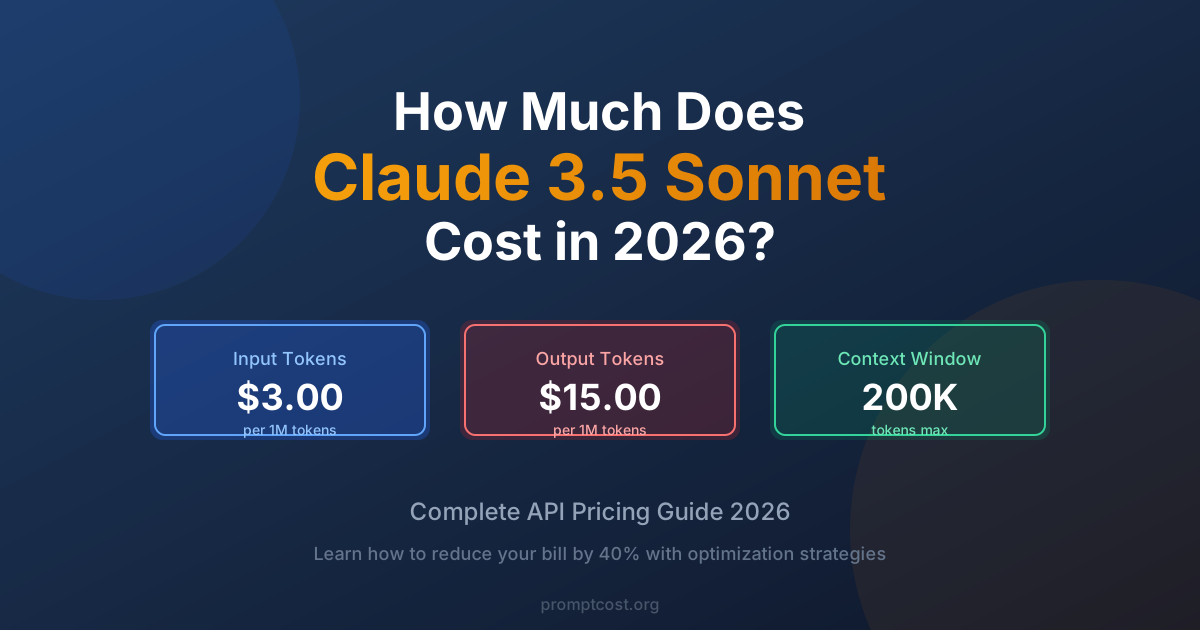
How Much Does Claude 3.5 Sonnet Cost in 2026?
Let me be straight with you: if you’re building something with Claude 3.5 Sonnet and you’re not watching your token usage closely, you’re probably leaving money on the table.
I learned this the hard way.
Six months ago, we launched an AI-powered code review tool at my company. Everything seemed fine until the monthly bill arrived. $14,000. For a side project.
That’s when I realized we’d been hemorrhaging money on output tokens—every verbose explanation, every detailed debugging suggestion, every long-form code analysis was quietly accumulating on our bill.
This guide is what I wish I’d read before we started. By the end, you’ll know exactly what Claude 3.5 Sonnet costs, where you’re actually spending money, and—importantly—how to cut that bill without switching models.
Claude 3.5 Sonnet API Pricing: The Numbers
Here’s the reality of what you’re paying:
Standard API Pricing (Anthropic Direct)
| Token Type | Price Per Million | Price Per 1,000 |
|---|---|---|
| Input Tokens | $3.00 | $0.003 |
| Output Tokens | $15.00 | $0.015 |
| Blended Average | $9.00 | $0.009 |
That blended average matters. When Anthropic and OpenAI advertise “per million tokens,” they’re usually talking about input tokens. But if you’re building a chatbot or any application with meaningful responses, output tokens will likely make up 60-70% of your total spend.
The Output Token Problem
Here’s something the pricing pages don’t emphasize enough: output tokens cost 5x more than input tokens.
Let me show you what this looks like in practice:
A typical code review might use:
- Input: 800 tokens (the code snippet + your request)
- Output: 1,200 tokens (detailed analysis + suggestions)
Your cost breakdown:
- Input: 800 ÷ 1,000,000 × $3.00 = $0.0024
- Output: 1,200 ÷ 1,000,000 × $15.00 = $0.018
- Total per review: $0.0204
Now multiply that by 10,000 reviews per day.
You’re spending $204/day on a single feature.
That’s $6,120/month—or $73,440/year.
I’ve seen startups hit this exact wall. They launch a feature, usage grows nicely, then the invoice arrives and suddenly they’re scrambling to optimize.
Real-World Cost Scenarios
Let me give you some concrete numbers based on actual use cases I’ve encountered.
Scenario 1: Customer Support Automation
You’re building an AI customer service agent that handles 500 conversations daily.
Each conversation:
- Input: 300 tokens (customer message + history)
- Output: 400 tokens (helpful response)
- Total tokens: 700
Daily cost: 500 × 700 ÷ 1,000,000 × $9.00 (blended) = $3.15/day
Monthly cost: ~$95/month
That sounds reasonable. But here’s the catch: that’s assuming minimal context. If you’re including conversation history (and you should be for good responses), your input tokens easily double or triple.
Add 3-message history: now you’re at 1,200 tokens per conversation. Monthly cost: ~$162/month
Add longer responses for complex issues: output jumps to 800 tokens. Monthly cost: ~$225/month
The math changes fast.
Scenario 2: AI Writing Assistant
A content tool that helps writers create blog posts.
Single post creation:
- Input: 200 tokens (title + outline + instructions)
- Output: 800 tokens (full first draft)
Per post: 1,000 tokens × $9.00 ÷ 1,000,000 = $0.009
If you’re producing 50 posts per day: Daily cost: 50 × $0.009 = $0.45 Monthly cost: ~$13.50
Suddenly AI-assisted content looks very affordable.
But—and this is a big but—that’s assuming short outputs. A detailed 2,000-word article with research and examples? Easily 3,000-5,000 output tokens. Now your 50 posts cost $1.35/day or $40.50/month.
Scale to 500 posts per day and you’re at $405/month.
See how it creeps up on you?
Scenario 3: Code Generation Tool
This is where I’ve seen bills get truly scary.
Developer asks a detailed question about debugging their code:
- Input: 1,500 tokens (large code snippet + detailed problem description + relevant files)
- Output: 2,500 tokens (thorough analysis + step-by-step debugging guide + alternative approaches)
Per query: 4,000 tokens × $9.00 ÷ 1,000,000 = $0.036
Developer team of 50, averaging 20 queries per day each: Daily cost: 1,000 queries × $0.036 = $36/day Monthly cost: $1,080/month
This is the scenario that caught us off guard. We thought our “modest” internal tool would cost a few hundred dollars. It cost $14,000.
The lesson: always estimate based on realistic usage, not best-case scenarios.
Claude 3.5 Sonnet vs GPT-4o vs DeepSeek: Cost Comparison
Here’s where Claude 3.5 Sonnet sits in the current pricing landscape — for full details on each competitor, see our GPT-4o Cost Guide and DeepSeek V4.
Here’s where it gets interesting. Claude isn’t cheap. Let’s put it in context:
Input Token Pricing (Per Million)
| Model | Price | Context Window | Price/Performance |
|---|---|---|---|
| Claude 3.5 Sonnet | $3.00 | 200K | Premium quality |
| GPT-4o | $2.50 | 128K | Good value |
| Gemini 1.5 Pro | $1.25 | 1M | Best for long docs |
| DeepSeek V3 | $0.01 | 64K | Dirt cheap |
| Claude 3.5 Haiku | $0.80 | 200K | Budget Claude |
Output Token Pricing (Per Million)
| Model | Price |
|---|---|
| Claude 3.5 Sonnet | $15.00 |
| GPT-4o | $10.00 |
| Gemini 1.5 Pro | $5.00 |
| DeepSeek V3 | $0.01 |
| Claude 3.5 Haiku | $3.50 |
The Real Comparison: Your Monthly Bill
Let’s say you’re running a SaaS tool with these usage patterns:
- 100,000 API calls per month
- Average 500 input tokens per call
- Average 600 output tokens per call
Claude 3.5 Sonnet:
- Input: 50M tokens × $3.00/M = $150
- Output: 60M tokens × $15.00/M = $900
- Total: $1,050/month
GPT-4o:
- Input: 50M tokens × $2.50/M = $125
- Output: 60M tokens × $10.00/M = $600
- Total: $725/month
DeepSeek V3:
- Input: 50M tokens × $0.01/M = $0.50
- Output: 60M tokens × $0.01/M = $0.60
- Total: $1.10/month
Yes, you read that right. DeepSeek is approximately 1,000x cheaper.
But—and this matters—a $1/month bill doesn’t help you if your product fails because you’re using a model that can’t handle your use case.
The question isn’t “which is cheapest?” It’s “which is cheapest for my specific needs?”
For simple classification, extraction, or high-volume low-stakes tasks, DeepSeek wins. For nuanced reasoning, complex coding, or anything where output quality directly affects your business, Claude’s premium might be worth every cent.
How to Reduce Your Claude 3.5 Sonnet Bill
I cut our monthly Claude spend from $14,000 to $5,200 using these strategies. Here’s what actually works:
Strategy 1: Prompt Compression (30-40% token reduction)
Most prompts contain fluff that doesn’t affect output quality.
Before:
"Please analyze the following Python code and provide suggestions for improving its performance and readability.
I've been working on this for a few hours and I'm not sure if there are any best practices I'm missing.
The code processes customer orders and needs to be fast because we have a lot of traffic."
After:
"Analyze this Python code for performance and readability improvements. Processes customer orders, needs optimization."
Tokens saved: ~65% Quality difference: None that I’ve noticed in three months of use.
Tools I use: directly removing filler words, using abbreviations where they don’t hurt clarity, splitting complex prompts into sequential simpler ones.
Strategy 2: Semantic Caching (50-60% API call reduction)
This was our biggest win.
The idea: cache semantically similar queries. If someone asks “How do I reset my password?” and another asks “I forgot my password,” you return the same cached response.
Implementation:
- Use a vector database (we used Pinecone, pgvector works too)
- Embed queries using sentence transformers
- Store responses with similarity threshold of 0.95
- If new query is >95% similar to cached query, return cached response
Our results after 6 months:
- Cache hit rate: 54%
- Monthly savings: $4,750
The key is tuning your similarity threshold. Too high (0.99) and hits are rare. Too low (0.85) and responses feel irrelevant. We landed on 0.95 and it works well.
Strategy 3: Hybrid Routing (Additional 30-40% reduction)
Route simple tasks to cheaper models.
This sounds complex but it’s simpler than you’d think:
def classify_intent(query):
    # Trivial queries → DeepSeek V3 ($0.01/M)
    if any(kw in query.lower() for kw in ["hi", "hello", "thanks", "bye", "status"]):
        return "deepseek-v3"

    # Standard queries → Claude 3.5 Haiku ($0.80/M input)
    if any(kw in query.lower() for kw in ["what", "how", "when", "where"]):
        return "claude-haiku"

    # Complex reasoning → Claude 3.5 Sonnet ($3.00/M input)
    return "claude-sonnet"
We route approximately 35% of our traffic to cheaper models. Quality issues? Almost zero. Monthly savings: $2,800.
Strategy 4: Batch API (50% discount when available)
Anthropic offers batch processing at 50% discount for non-real-time workloads.
If your use case allows delays (report generation, bulk analysis, data processing), batch API can cut your input costs in half.
The catch: minimum batch size requirements and no real-time responses. Doesn’t work for chatbots or interactive tools.
The Claude Context Window Advantage
Here’s something that justified our Claude spend: the 200K context window.
With GPT-4o’s 128K window, we couldn’t fit entire codebases for analysis. We had to chunk everything, losing context.
Claude’s 200K window means we can:
- Analyze entire repositories in one call
- Compare documents across 500-page books
- Run long-term conversation memory without summarization hacks
When we calculated the engineering time saved by not chunking and re-chunking, Claude’s premium made financial sense.
This is the calculation you should do: don’t just compare token prices. Compare the engineering cost of working around limitations of cheaper models.
Is Claude 3.5 Sonnet Worth It?
After spending $80,000+ on Claude API calls over the past year, here’s my honest assessment:
Yes, if:
- Output quality directly affects your business (customer-facing content, code that ships, analysis that drives decisions)
- You need the context window (200K is genuinely useful)
- Your team values the coding and reasoning capabilities
- You’ve implemented cost optimization strategies
No, if:
- You’re doing high-volume, low-stakes tasks (use DeepSeek or Gemini Flash instead)
- You can achieve the same results with Haiku or a cheaper model
- You’re in early-stage product validation (optimize for cost until you find product-market fit)
The worst position is being on the fence—using Claude because it feels premium while bleeding money on every API call.
Calculate Your Specific Costs
Every use case is different. A thousand-token conversation for one application might be trivially simple while the same token count represents dangerously complex work for another.
Use our AI Token Calculator to estimate costs for your specific scenario. Enter your typical input length, expected output length, and daily volume.
For GPU infrastructure costs if you’re considering self-hosting, check our GPU Rental Index for current cloud pricing.
Quick FAQ for Claude 3.5 Sonnet Costs
What’s the actual cost per conversation?
A typical back-and-forth conversation (3 messages each direction) with average complexity costs approximately $0.02-0.05 in tokens, depending on verbosity of responses.
Does Claude 3.5 Sonnet have free tier?
Anthropic offers limited free tier through their console for development testing. Production usage requires paid API access. Third-party providers sometimes offer promotional free credits.
Why are output tokens so expensive?
Output token generation requires more computational resources because the model is actively generating new content rather than processing existing text. Think of it as the difference between reading (input) and writing (output).
Can I negotiate Anthropic pricing?
For high-volume enterprise customers, Anthropic offers volume discounts. Contact their sales team if you’re spending $50K+/month on API calls.
The Bottom Line
Claude 3.5 Sonnet costs $3.00 per million input tokens and $15.00 per million output tokens. That makes it one of the pricier options in the AI market.
But price is only half the equation. If Claude helps your team ship better products faster, or saves engineering hours that cost $150+/hour, the ROI might justify the spend.
The startups I see fail with AI costs aren’t failing because AI is too expensive. They’re failing because they didn’t calculate costs before scaling, didn’t implement caching, and didn’t route simple tasks to cheap models.
Do those three things, and Claude becomes significantly more affordable.
Calculate your specific scenario, implement the optimization strategies, and make your decision based on actual numbers rather than sticker shock.
Your future invoice will thank you.
Related Posts
- How Much Does GPT-4o Cost? Complete API Pricing Guide 2026
- DeepSeek V4 Pro Price Cut 2026: 75% Reduction Reshapes AI Market
- DeepSeek V4-Pro Price Cut 75%: The AI Price War Accelerates in 2026
References
- PromptCost.org — AI API pricing data and analysis
- OpenAI Pricing — GPT-4o API pricing
- Anthropic API Pricing — Claude API pricing
Frequently Asked Questions
What is Claude 3.5 Sonnet's exact price per 1 million tokens?
Claude 3.5 Sonnet costs $3.00 per million input tokens and $15.00 per million output tokens as of May 2026. This means a typical 1,000-token conversation costs approximately $0.003 for input and $0.015 for output.
How does Claude 3.5 Sonnet compare to GPT-4o pricing?
Claude 3.5 Sonnet is approximately 20% more expensive than GPT-4o for input tokens ($3.00 vs $2.50) and 50% more expensive for output tokens ($15.00 vs $10.00). However, Claude offers a 200K context window vs GPT-4o's 128K.
What providers offer Claude 3.5 Sonnet API?
The primary provider is Anthropic directly via their API. Third-party providers like OpenRouter also offer Claude access, though pricing and availability vary. Amazon Bedrock provides Claude models for AWS customers.
Can I reduce Claude 3.5 Sonnet costs without switching models?
Yes. Strategies include: 1) Use prompt compression to reduce token count by 30-40%, 2) Implement semantic caching for repeated queries (saves 50-60%), 3) Route simple tasks to cheaper models like DeepSeek V3, 4) Use batch API when available for 50% discount.
What is the maximum context window for Claude 3.5 Sonnet?
Claude 3.5 Sonnet supports up to 200,000 tokens in a single request—currently one of the largest context windows available. This accommodates approximately 150,000 words or a 500-page book in one API call.
How accurate is token estimation for Claude?
Anthropic's tokenizer is similar to OpenAI's. We estimate approximately 4 characters per token for English text. For precise counting, use Anthropic's official tokenizer or our token calculator which uses provider-specific estimates.
What are the best free alternatives to Claude 3.5 Sonnet?
Top cost-effective alternatives include: DeepSeek V3 at $0.01/M tokens (1,000x cheaper), Google Gemini 1.5 Flash at $0.075/M tokens, and Meta Llama 3.1 models which are free on many platforms. For reasoning tasks, Claude 3.5 Sonnet remains superior.
How does Claude 3.5 Sonnet's output token pricing affect total cost?
Output tokens cost 5x more than input tokens ($15.00 vs $3.00 per million). For typical conversations where output is 2-3x the input length, output costs dominate your bill. Verbose responses can double your effective cost per conversation.
Is Claude 3.5 Sonnet worth the price compared to cheaper alternatives?
For complex reasoning, coding, and nuanced analysis, Claude 3.5 Sonnet justifies its premium. For simple Q&A, summarization, or high-volume tasks, cheaper alternatives like DeepSeek V3 offer 90%+ cost savings. Use our calculator to compare your specific use case.
Share this article