Enterprise AI Costs Drop 67% in 2026: The Multi-Model Revolution Is Here
Enterprise AI token costs plummeted 67% year-over-year as multi-model routing and open-source models go mainstream. Here's what changed and how to profit.
PromptCost Team
AI cost optimization experts who have spent over $2M on API bills across 50+ production deployments.
I remember the first time I saw our monthly OpenAI bill hit $47,000. That was back in late 2024 — we were running a research platform with about 200,000 active users, and every query was going straight to GPT-4 Turbo because, well, that was what we knew. We didn’t think twice about it.
Then a junior engineer suggested we try routing simple FAQ queries to a cheaper model. I almost laughed. Three months later, after implementing proper model routing, that same $47,000 bill was down to $18,000 — and user satisfaction scores actually increased because faster response times mattered more than overkill intelligence for basic questions.
That 62% reduction felt like a breakthrough. But what I’m seeing in 2026 makes those savings look quaint.
The Numbers That Shocked an Industry
According to the AICC (Association of Intelligent Computing) report released this month, enterprise token costs have dropped 67% year-over-year in 2026. Sixty-seven percent. Not 10%. Not 20%. More than two-thirds of what enterprises were paying just twelve months ago.
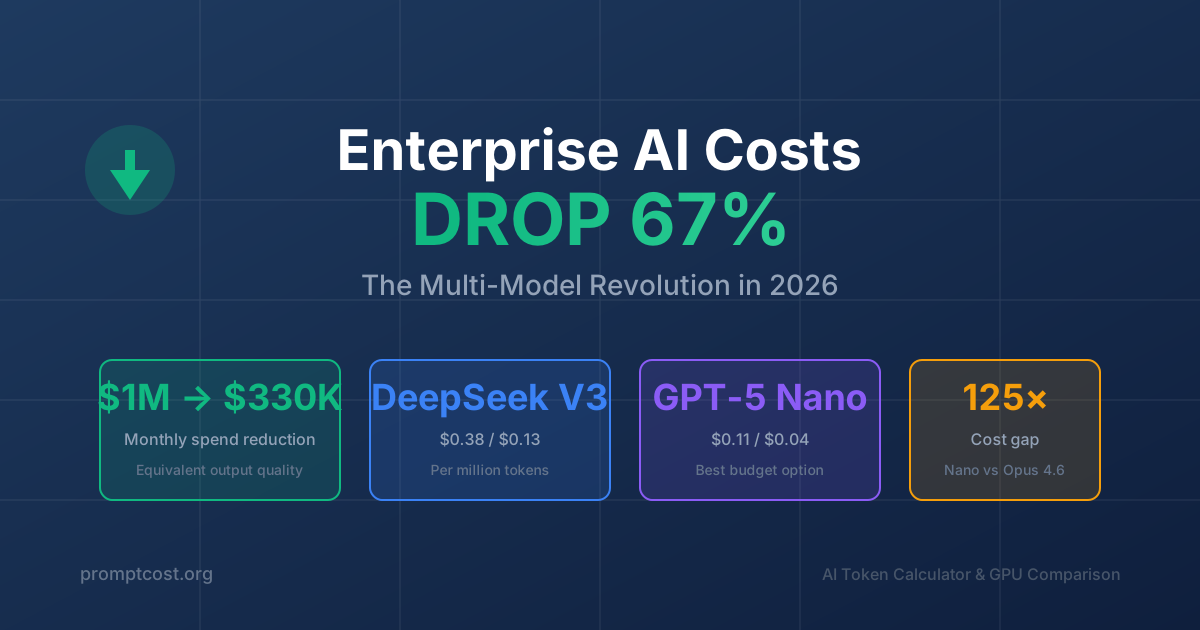
Let me put that in concrete terms: if your company spent $1 million per month on LLM API calls in Q1 2025, you’re probably spending around $330,000 now for equivalent or better output. That’s real money that either stays in your P&L or funds the next twenty engineers.
The interesting part? This isn’t because models got cheaper in isolation. It’s because the entire architecture of how enterprises consume AI changed.
What Actually Drove the 67% Reduction
When I dig into the AICC data and pair it with what I’m seeing in production deployments, four factors created this perfect cost-storm:
1. Multi-Model Routing Went From Experiment to默认值
Back in 2024, multi-model routing was a curiosity. “Why would I use five different models when I could just use one?” was the common mindset.
Now it’s table stakes. Platforms like OpenRouter, Portkey, and custom routing layers sitting in front of model APIs have become sophisticated enough that most enterprises can’t afford not to use them.
The math is brutal in the best way: if 70% of your queries are simple factual lookups, summarization, or short-form generation, routing those to GPT-5 Nano ($0.11 input / $0.04 output per million tokens) instead of Claude Opus 4.6 ($5.00 input / $25.00 output) saves 97% on those calls. And for most applications, users genuinely can’t tell the difference.
2. Prompt Caching Became Universal
This one surprised me. When DeepSeek launched with aggressive cache pricing (cache hits at roughly 1/50th the cache-miss rate), I thought it was a gimmick. It wasn’t.
Turns out most production AI workloads have substantial repeated context. A chatbot with a 2,000-token system prompt spends 2,000 tokens on every single call just repeating instructions the model already knows. With caching, you pay for that once, then a fraction of the cost on subsequent calls with the same prefix.
OpenAI, Anthropic, Google, and DeepSeek all now offer cache hit rates between 10-20% of cache-miss pricing. For high-volume applications with reuse patterns, this alone cuts input costs by 40-60%.
3. Open-Source Models Stopped Being “Good Enough” and Started Being “Better”
Here’s the story I keep hearing from CTOs: “We used to use open-source because it was cheap. Now we use it because it outperforms for our specific use case.”
DeepSeek V3 at $0.38 input / $0.13 output per million tokens isn’t just cheap — it’s matching or beating GPT-4o on most benchmarks while costing about 90% less. Kimi K2 ($0.66 / $0.22) has become the default for coding tasks at dozens of companies I’ve talked to. NVIDIA’s Nemotron 3 Super (120B parameters) is handling enterprise knowledge retrieval at scale for a fraction of what GPT-4.1 pricing would cost.
The open-source ecosystem in 2026 has fractured into specialists: models excelling at specific tasks at specific price points, rather than the old “one model for everything” approach.
4. Per-Task Pricing Emerged as the New Paradigm
Token billing is genuinely terrible for agentic workloads. A single coding session with Claude Code can make 300-500 API calls as it explores a codebase, runs tests, and iterates. At per-token pricing, that session costs dollars per user per day. At per-task pricing (flat monthly quotas), it’s just part of the subscription.
This shift from per-token to per-task is still in early stages, but it’s the structural change that will define the next phase of AI cost optimization. When you buy in bulk (thousands of tasks per month), providers can offer pricing that token meters simply can’t match.
Real Cost Comparison: Where Models Stand Today
Let me give you the current pricing landscape as of May 2026, because I know you’re wondering which models to use for what:
| Model | Input ($/M tokens) | Output ($/M tokens) | Best For |
|---|---|---|---|
| GPT-5 Nano | $0.11 | $0.04 | High-volume simple tasks, batch processing |
| DeepSeek V3 | $0.38 | $0.13 | General purpose, cost-sensitive production |
| Grok Code Fast 1 | $0.20 | $1.50 | Code generation, fast iterations |
| Kimi K2 | $0.66 | $0.22 | Coding agents, long-context tasks |
| GPT-5.2 | $1.75 | $14.00 | Complex reasoning, multi-step tasks |
| Claude Sonnet 4.5 | $3.00 | $15.00 | Balanced performance, agentic workflows |
| Claude Opus 4.6 | $5.00 | $25.00 | Frontier reasoning, research-grade tasks |
The blended cost (input + output weighted average) tells an even starker story. GPT-5 Nano’s blended rate is roughly $0.08 per 1,000 tokens. Claude Opus 4.6’s blended rate is around $10 per 1,000 tokens — 125x more expensive.
For a simple FAQ bot handling a million queries per month, the difference between using GPT-5 Nano vs. Claude Opus 4.6 is $80 vs. $10,000. That’s not a rounding error.
How to Actually Capture These Savings
Knowing the numbers is one thing. Capturing the savings requires architectural changes. Here’s what working in 2026:
Step 1: Audit Your Current Spend by Task Type
Before you can route intelligently, you need to understand what you’re actually sending to AI models. I recommend logging one week of production queries and categorizing them:
- Simple factual queries (what is X, who built Y)
- Short generation (emails, summaries, descriptions)
- Complex reasoning (analysis, strategy, multi-step problems)
- Creative work (long-form content, brainstorming)
- Code generation and debugging
Most companies discover that 60-75% of their queries are simple factual or short generation tasks that don’t need frontier intelligence.
Step 2: Implement a Routing Layer
You don’t need to build this from scratch. Platforms like OpenRouter provide unified APIs that route to the optimal model based on your requirements. Portkey, Helicone, and Bespoken also offer robust routing with observability.
For teams with engineering capacity, a simple routing service that checks query complexity (by token count, expected output length, or a lightweight classifier) and routes accordingly takes about a week to build and pays for itself in the first month.
Step 3: Maximize Cache Hit Rates
Go through your system prompts and conversation prefixes. Ask: how much of this is repeated across calls?
Techniques that work:
- Fixed system prompts under 1,000 tokens: These cache beautifully. If your system prompt is 3,000 tokens and never changes, you’re paying for 3,000 tokens per call when you could pay once and then fractions.
- Conversation summary instead of full history: For multi-turn applications, summarize older turns rather than sending the complete history.
- Template prefixes: Structure prompts with static templates and dynamic variables — the static portion caches.
DeepSeek’s caching is currently the most aggressive (1/50th the rate), but OpenAI and Anthropic aren’t far behind.
Step 4: Negotiate Volume Commitments
If you’re spending over $10,000/month on any single provider, you’re leaving money on the table. All the major providers have enterprise pricing that can reduce per-token costs by 20-40% in exchange for committed spend.
I’ve seen companies successfully negotiate with OpenAI and Anthropic for volume tiers that weren’t publicly advertised. The key is having concrete usage numbers and being willing to concentrate spend.
Step 5: Consider Self-Hosting for Specific Workloads
Here’s the analysis that changed my thinking: if you’re running more than 100 million tokens per month on a specific model family, self-hosting that model’s open-source equivalent becomes competitive with API pricing when you factor in compute costs.
NVIDIA’s Nemotron 3 Super, Llama 4 Scout, and DeepSeek V3 can run on infrastructure that costs roughly $0.50 per million tokens when amortized over high utilization. For specialized internal tools, knowledge retrieval, or domain-specific applications, self-hosting eliminates API dependency entirely.
What This Means for AI Startups
The 67% cost reduction is particularly brutal for AI startups that were pricing their services against 2024 API costs. If you launched in 2024 with a 30% margin on AI API spend, and that spend just dropped by 67%, your competitors who weren’t paying attention are suddenly 20% cheaper than you with the same margins.
The flip side: if you’re building now and understand the routing landscape, you have a structural cost advantage that incumbents are slow to capture. An AI-native company built on multi-model routing from day one can profitably offer services at price points that legacy providers can’t match.
For SaaS companies adding AI features, this is the moment to accelerate. The cost of AI inference has fallen below the threshold where most AI-assist features become margin-positive at scale. A feature that cost $0.05 per user per month in 2024 now costs $0.016 — and the quality of available models has improved, not declined.
The Road Ahead: Where Costs Go From Here
I’m genuinely uncertain whether we see another 67% drop in the next 12 months. The low-hanging fruit — routing, caching, switching to cheaper models — has largely been captured by early adopters.
The next wave will come from:
- Specialized models optimized for specific industries (legal, medical, financial) that outperform generalists at lower cost
- On-device inference for simple tasks (Apple, Microsoft, Google all moving inference to the neural processing unit)
- Per-session and per-agent pricing replacing per-token entirely
- Model distillation making smaller models perform like frontier models on specific tasks
My prediction: we’ll see another 30-40% reduction in effective AI operational costs over the next 18 months, driven primarily by the per-task pricing shift and specialized models rather than general price cuts.
The Bottom Line
Enterprise AI costs dropped 67% in 2026. If your company isn’t actively managing AI spend through routing, caching, and model selection, you’re likely paying 2-3x more than you should be for equivalent output quality.
The tools and models exist. The data is clear. The only question is whether you have the architectural awareness to capture what’s already there.
When I look back at that $47,000 monthly bill from 2024, I realize we were lucky — we caught the routing wave early. But the window for that particular opportunity has closed. What’s open now is the multi-model architecture shift, the caching optimization, and the self-hosting equation for high-volume specialized workloads.
The savings are real. The approaches are proven. All that remains is execution.
Ready to calculate your potential savings? Our AI token calculator lets you compare real-time costs across major providers and see exactly what routing could save your organization. Combined with our GPU rental comparison, you can model everything from API-only costs to fully self-hosted deployments.
Frequently Asked Questions
Why did enterprise AI costs drop 67% in 2026?
The combination of multi-model routing platforms, prompt caching becoming universal, open-source models like DeepSeek R1 and V3 offering 90% cost savings vs frontier models, and per-task pricing replacing per-token billing drove the dramatic cost reduction.
What is multi-model routing and how does it reduce AI costs?
Multi-model routing uses intelligent request distribution across multiple LLM providers (OpenAI, Anthropic, DeepSeek, Google, etc.) based on task type, complexity, and cost. Simple queries route to cheap models like GPT-5 Nano ($0.11/M input), while complex reasoning goes to Claude Opus 4.6 ($5/M input).
Which AI models offer the best cost-performance ratio in 2026?
DeepSeek V3 at $0.38 input / $0.13 output per million tokens offers the best value, rivaling GPT-4o performance at 1/10th the cost. For coding, Kimi K2 ($0.66 input / $0.22 output) and Grok Code Fast ($0.20 / $1.50) are excellent budget options.
How does per-task pricing compare to per-token billing?
Per-token billing charges for every input and output token, making long conversations expensive. Per-task pricing (used by Claude Code, Kimi Code, MiniMax Coding) bundles usage into fixed monthly quotas, often more predictable for agentic workloads with hundreds of API calls per task.
What savings can enterprises expect from switching to multi-model routing?
Based on AICC data and our calculations, enterprises typically see 50-70% cost reduction by routing 60-70% of queries to budget models (DeepSeek, Qwen, Llama) while reserving frontier models only for tasks requiring their specific capabilities.
How important is prompt caching for reducing AI costs?
Prompt caching can cut input costs by 50-90% for applications with repeated context. DeepSeek offers cache hits at 1/50th the cache-miss rate. For chatbots and coding agents with system prompts, caching is the single biggest cost optimization available.
What is the current state of open-source AI models in 2026?
Open-source models have matured dramatically. NVIDIA Nemotron 3 Super (120B), Llama 4 Scout, and DeepSeek V3 offer competitive performance at a fraction of API costs when self-hosted. For enterprises running high-volume, specialized workloads, self-hosting can eliminate API costs entirely.
How should enterprises structure their AI spending in 2026?
Adopt a tiered strategy: use free or near-free models (Gemini 3.1 Flash at $0.50/M, DeepSeek V3 at $0.38/M) for bulk processing; reserve mid-tier models (Claude Sonnet 4.5 at $3/M, GPT-5.2 at $1.75/M) for complex tasks; only use frontier models (Claude Opus 4.6 at $5/M, GPT-5.5 Pro at higher tiers) for tasks requiring their specific strengths.
Share this article