DeepSeek-R1 vs GPT-4o API War: The $100,000 Logic Gap in 2026
In 2026, DeepSeek-R1 offers near-identical reasoning to GPT-4o at 1/20th the cost. Learn when to use each model and how to build a hybrid routing strategy.
PromptCost Engineering Team
AI infrastructure cost analysts tracking API pricing trends and model performance metrics since 2023.
Quick Answer
In 2026, the arrival of DeepSeek-R1 has forced a total re-evaluation of AI budgets. While GPT-4o remains the gold standard for multi-modal fluidity and creative nuance, DeepSeek-R1 offers near-identical reasoning performance at one-twentieth of the cost. For high-volume logic tasks, switching from GPT-4o to R1 can reduce a monthly 10,000 dollar API bill to just 500 dollars. Use our AI Token Calculator to compare your exact costs.
The Collapse of the Intelligence Premium
For years, the AI market followed a predictable trajectory: if you wanted a model that could think (reason, debug, and self-correct), you had to pay the OpenAI Tax. GPT-4 was the only game in town for complex logic, and its pricing reflected that monopoly.
2026 has officially ended that era. DeepSeek-R1 did not just compete on quality; it performed a tactical massacre on AI pricing tiers. At PromptCost.org, our live data shows that for the first time in history, the cost of high-tier reasoning has dropped below the cost of standard chat.
1. The Mathematics of Reasoning: Cost Per Million Tokens
Let us look at the brutal reality of the 2026 API market. When we compare GPT-4o (Closed Weights) against DeepSeek-R1 (Open Weights and API), the ROI is not just a slight improvement. It is a business-saving transformation.
Comparison Table: One Million Tokens (Blended Input and Output)
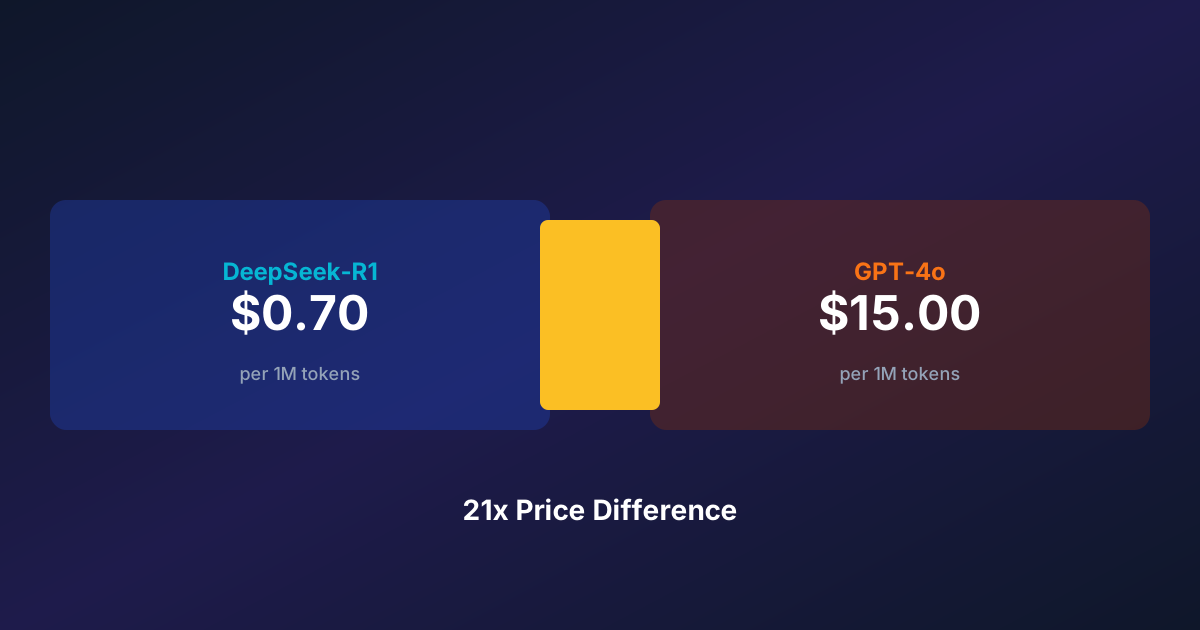
GPT-4o: approximately 15.00 dollars DeepSeek-R1 (via DeepSeek API): approximately 0.70 dollars DeepSeek-R1 (via OpenRouter or Groq): approximately 0.85 dollars (with higher rate limits)
The Latte Factor: Processing a massive codebase (10 million tokens) with GPT-4o costs as much as a high-end dinner for two (150 dollars). Doing the same with DeepSeek-R1 costs as much as two lattes (7 dollars). When you scale this to a production app with 1,000 users, we are talking about the difference between a profitable Boring Business and a bankrupt cash-burn machine. Calculate your exact savings with our Token Cost Calculator.
2. Logic vs. Polish: Where GPT-4o Still Wins
It would be a mistake to say GPT-4o is dead. While R1 wins on price and pure logic (Math and Coding), GPT-4o still holds the crown in Nuance and Safety.
Creative Nuance: GPT-4o is significantly better at following complex stylistic instructions (for example, “Write a legal brief in the style of a 19th-century poet”).
Multi-modal Fluidity: GPT-4o handles images, audio, and video natively with much lower latency.
Refusal Rates: DeepSeek-R1 can be overly sensitive or preachy due to its specific RLHF tuning.
3. The Thinking Token Trap: Hidden Latency Costs
One thing users of our calculator notice is that DeepSeek-R1 has a unique output type: Thinking Tokens.
Before giving you an answer, the model thinks in a hidden scratchpad.
First: You pay for these tokens. Even though you do not see them in the final UI, they are part of the API cost.
Second: Latency is the trade-off. DeepSeek-R1 is a slow-burn model. If your app requires instant, snappy responses (like a live sales bot), GPT-4o-mini is still your best friend. If your app needs to solve a complex bug, R1 is the king.
4. Scaling Strategy: The Hybrid Router Approach
The most successful companies in 2026 are not choosing one model. They are using a Model Router (a concept we track closely at PromptCost).
Step 1: User submits a prompt.
Step 2: A tiny, cheap model (Gemini 1.5 Flash) classifies the difficulty.
Step 3: If it is a simple chat, use GPT-4o-mini. If it is a Reasoning task, route it to DeepSeek-R1.
ROI Result: This hybrid strategy typically saves 85 percent on costs while maintaining Omni-level performance. For a full comparison of model pricing, check our GPU Rental Index.
5. The Coffee Index for API Spending
At PromptCost.org, we use the Coffee Index to simplify AI budget decisions.
Under 10 dollars monthly: Stick to standard APIs. No need for complex routing.
200 dollars monthly: You are in the Cloud GPU zone. Consider running your own models.
600 dollars or more monthly: You are buying a GPU for someone else every 3 months. It is time to bring that hardware in-house or negotiate volume discounts with your API provider.
Authority FAQ
Question 1: Is DeepSeek-R1 safe for enterprise data?
If you use their API, your data is subject to their privacy policy. However, because R1 is Open Weights, an enterprise can host it on their own private servers, ensuring 100 percent data sovereignty. You cannot do this with GPT-4o.
Question 2: Why is DeepSeek so much cheaper to run?
They use an architecture called Mixture of Experts. Instead of activating the whole brain for every word, they only use the specific 5 to 10 percent of the model that is relevant to the question. This massive efficiency is passed on to the customer.
Question 3: Does GPT-4o have Thinking Tokens?
Standard GPT-4o does not show its internal reasoning. However, OpenAI o1 and o3 series do use a similar reasoning process. Compared to o1, DeepSeek-R1 is roughly 30 times cheaper for similar logic levels.
Question 4: Which model is better for coding?
For pure Python, C++, and Rust logic, DeepSeek-R1 is currently rated higher in most benchmarks (SWE-bench). For System Design and architectural advice, GPT-4o is generally more helpful.
Question 5: How does the Coffee Index help me choose?
If your daily API usage costs more than a Venti Latte, you should immediately test a migration to DeepSeek-R1. If it is less than a double espresso, the complexity of switching might not be worth your time yet.
Question 6: Can DeepSeek-R1 handle large context windows?
Yes, it supports up to 128k context, similar to GPT-4o. However, because R1 generates Thinking Tokens, you can hit the context limit faster if the model starts over-thinking a problem. For more details on context windows and model selection, see our GPU Memory Requirements guide.
Question 7: Will OpenAI lower their prices to compete?
They already are. Every time a model like DeepSeek-R1 drops, OpenAI and Anthropic respond with Mini versions or price cuts. This is the Golden Age for AI consumers.
Question 8: What is the biggest risk of switching to DeepSeek?
Regional latency. Depending on where you are, API calls to DeepSeek primary servers (in Asia) might be slower than calls to OpenAI US-based servers. Using a global aggregator like OpenRouter is the best way to mitigate this.
Published by PromptCost.org Engineering Team. Your Authority in AI Economics.
Related Posts
- OpenAI o1 vs o3 vs GPT-4o: Complete Reasoning Model Cost Comparison 2026
- GPT-4o vs Claude 3.5 Sonnet vs MiniMax m2.7: The 2026 Cost-Per-Intelligence Index
References
- PromptCost.org — AI API pricing data and analysis
- OpenAI Pricing — GPT-4o API pricing
- Anthropic API Pricing — Claude API pricing
Frequently Asked Questions
Is DeepSeek-R1 safe for enterprise data?
If you use their API, your data is subject to their privacy policy. However, because R1 is Open Weights, an enterprise can host it on their own private servers, ensuring 100 percent data sovereignty. You cannot do this with GPT-4o.
Why is DeepSeek so much cheaper to run than GPT-4o?
They use an architecture called Mixture of Experts. Instead of activating the whole brain for every word, they only use the specific 5 to 10 percent of the model that is relevant to the question. This massive efficiency is passed on to the customer.
Does GPT-4o have Thinking Tokens like DeepSeek-R1?
Standard GPT-4o does not show its internal reasoning. However, OpenAI o1 and o3 series do use a similar reasoning process. Compared to o1, DeepSeek-R1 is roughly 30 times cheaper for similar logic levels.
Which model is better for coding tasks?
For pure Python, C++, and Rust logic, DeepSeek-R1 is currently rated higher in most benchmarks. For System Design and architectural advice, GPT-4o is generally more helpful.
What is the Coffee Index threshold for switching to DeepSeek-R1?
If your daily API usage costs more than a Venti Latte, you should immediately test a migration to DeepSeek-R1. If it is less than a double espresso, the complexity of switching might not be worth your time yet.
Can DeepSeek-R1 handle large context windows?
Yes, it supports up to 128k context, similar to GPT-4o. However, because R1 generates Thinking Tokens, you can hit the context limit faster if the model starts over-thinking a problem.
Will OpenAI lower their prices to compete with DeepSeek?
They already are. Every time a model like DeepSeek-R1 drops, OpenAI and Anthropic respond with Mini versions or price cuts. This is the Golden Age for AI consumers.
What is the biggest risk of switching to DeepSeek?
Regional latency. Depending on where you are, API calls to DeepSeek primary servers in Asia might be slower than calls to OpenAI US-based servers. Using a global aggregator like OpenRouter is the best way to mitigate this.
Share this article